
A Space to Breathe in Venice
Amid the spectacle, geopolitical tensions, and sensory overload of the Venice Art Biennale this year, Marinaressa Gardens offers a quieter mode of encounter. Presented by the European Cultural Centre Italy, Personal Structures – Confluences transforms the public waterfront into a space for collective well-being. Drawing on conversations with curator Sara Danieli, this feature explores how art in public space can hold emotional complexity whilst fostering empathy and resilience. Through encounters with nature, sculpture, and people from diverse national and social backgrounds, Marinaressa Gardens proposes an alternative Biennale experience grounded in slowness, co-existence, and the restorative potential of shared space.
This article is commissioned as part of culture360.ASEF.org's Redefining 'Well-being' through Culture open call. Through a series of articles, video interviews and podcasts, we delve into the multidimensional contribution of culture towards good physical health, mental health, individual and societal well-being.
Slowing Down
Often described as the “Olympics of the art world”, the Venice Biennale opened this year amid mounting geopolitical tensions, institutional upheaval, protests from artists and cultural workers, and record high number of visitors. Against this frenetic atmosphere, the sculpture showcase at Marinaressa Gardens presented by the European Cultural Centre Italy (ECC Italy) offers an altogether different mood: a space to breathe.
Some 20 sculptures stand across the green spaces, where sea breeze, sunlight, and the lagoon encourage visitors to slow down, reset their attention, and reconnect with their surroundings. This attitude is captured through Meeting Point by Asmer Sultanova. The sculpture depicts the encounter between a hare and two tortoises — figures associated with contrasting speeds in the fable.
“Sometimes slowing down or waiting can lead to deeper and more meaningful connections. The more a person pauses and reflects, the more clearly the meaning of life can be seen and felt,” says Sara Danieli, Head of Art at ECC Italy and curator of 2026 Personal Structures – Confluences.
“Marinaressa is not only a refuge in a spatial sense, but also by mental and spiritual counts.”
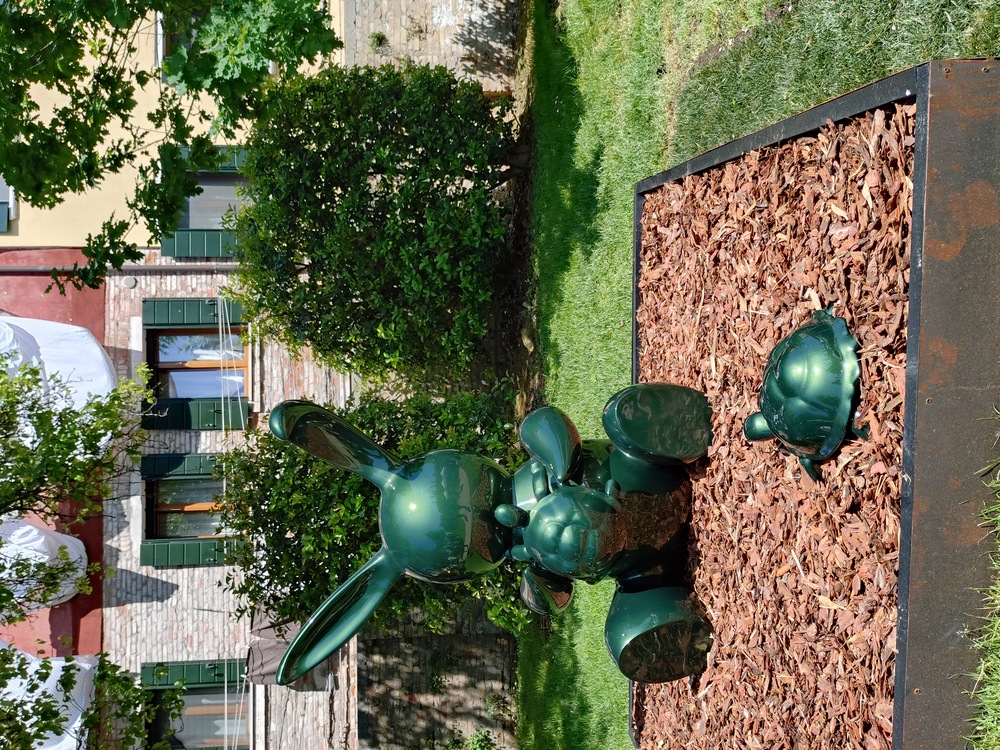
1. Meeting Point by Asmer Sultanova. Photo © Alison Lo.
Well-being Through Art in Open Space
Studies by the World Health Organisation have linked access to green spaces and cultural participation with lower stress levels, improved mental health, and stronger social cohesion. Marinaressa Gardens operates precisely within this intersection of environment, art, and collective well-being.
Unlike the compressed circulation of the Biennale’s main exhibitions and national pavilions, Marinaressa allows visitors to move freely without prescribed routes or time limits. “It is a living environment where contemporary art can create meaningful encounters between people, history, nature, and the city.” Danieli observes, “visitors do not feel the need to consume the experience all at once. Instead, they can revisit the space multiple times, encounter the artworks gradually, or simply spend time there without a specific agenda.”
This emotional balance is reflected in Equilibrium by Paresh Maity installed in the open landscape of the lagoon. “Composed of intersecting linear planes and vertical elements, the geometric brass sculpture suggests both stability and fragility,” the curator notes. “It’s a search for harmony.” This sculpture suggests that emotional well-being may emerge not from certainty, but from staying composed within instability.
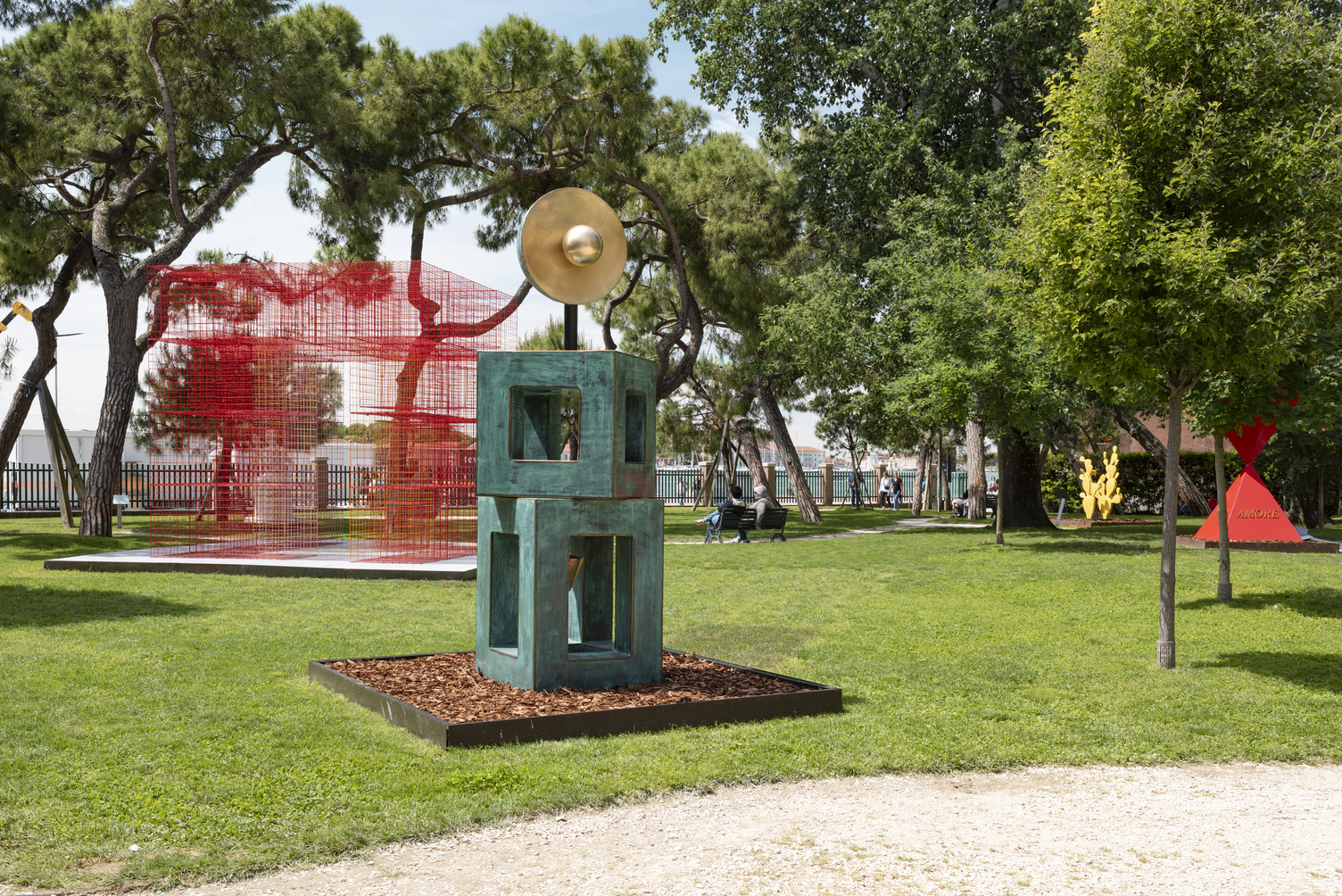
2. Equilibrium by Paresh Maity and other sculptures at Marinaressa Gardens. Photo © Matteo Losurdo.
Emotional Complexity
The central theme of the Biennale, conceived by the late curator Koyo Kouoh under the title In Minor Keys, proposes a curatorial approach attentive to lower frequencies and quiet tones, addressing melancholy and sorrow, but also joy, hope, and transcendence. ECC Italy’s Personal Structures – Confluences enters naturally into this sensibility. “Confluences means ‘to flow together’,” Danieli explains. “It evokes the image of rivers merging, intersecting and mixing to generate new currents, energies and directions.”
These parallel curatorial frameworks acknowledge that well-being is not the absence of tension, but the capacity to harbour complexity without collapsing into fragmentation. “We decided to move away from dominant voices, embracing instead co-existence, plurality, and emotional complexity,” Danieli says.
Positioned at the centre of Marinaressa is Inhabited Crate by Rashid Al Khalifa. The sculpture functions almost like a home — simultaneously protective and porous — inviting moments of sensory awareness inside out. “The work transforms a rigid modular structure into an open and permeable environment that visitors can physically enter and experience. It creates a moment of interaction and encounter, encouraging visitors to slow down and become more aware of their relationship with others and with the surrounding environment," says Danieli.
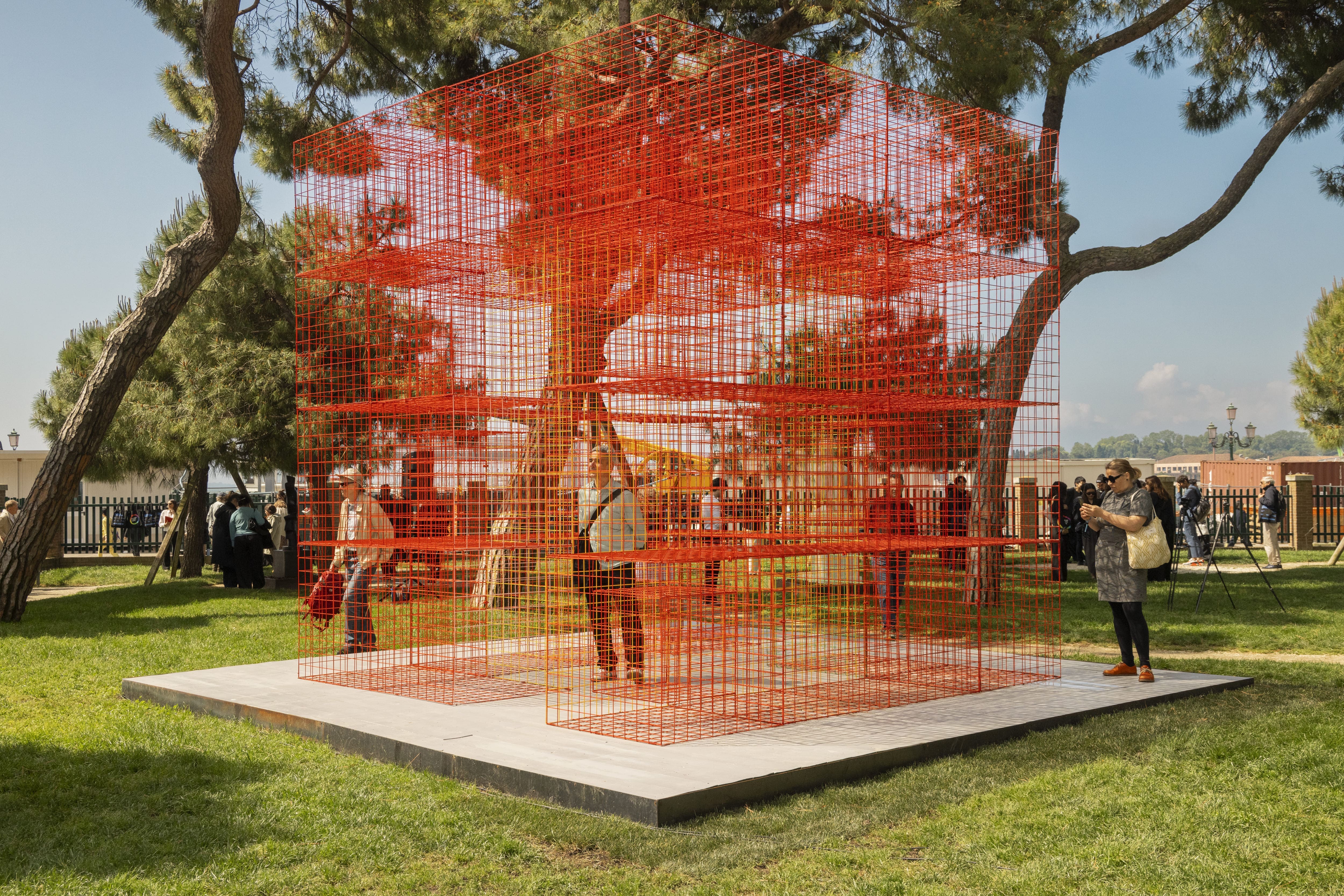
3. Inhabited Crate by Rashid Al Khalifa. Photo © Celestia Studio.
Empathy in a Polarised World
One of the defining structures of the Venice Biennale remains its national pavilion system. By contrast, ECC Italy positions itself outside these frameworks of representation. This year, Danieli brings together artists from more than 40 countries and diverse political and social backgrounds across Marinaressa Gardens and two palazzo venues. “Russian, Ukrainian, Israeli, Palestinian, and many other international artists exhibit together in our spaces, not through the erasure of differences, but through the possibility of meaningful dialogues amongst identities that lead to renewed understandings,” Danieli explains.
Geopolitical tensions of the Biennale aside, Venice is also a battlefield of overtourism. However, at Marinaressa Gardens, tourists and locals join each other to share the moment, be it over a lunch picnic or a conversation about the city and the weather, and the boundaries between exhibition space and civic space begin to dissolve. “I find this co-existence between art and ordinary life very meaningful,” she notes. “This allows visitors to experience art not as something distant or confined within institutional walls, but as something alive and integrated into everyday life.”
Pointing to King Arthur by miramondo, Danieli observes:
“This is where confluence begins, and continues. It offers a point of access, acknowledging that public space is inhabited by people with diverse needs, backgrounds and rhythms.”
The table-bench installation invites people to converse and connect. In an increasingly polarised world, the Gardens propose a form of collective well-being grounded not in consensus, but in empathy and the ability to remain present with differences.
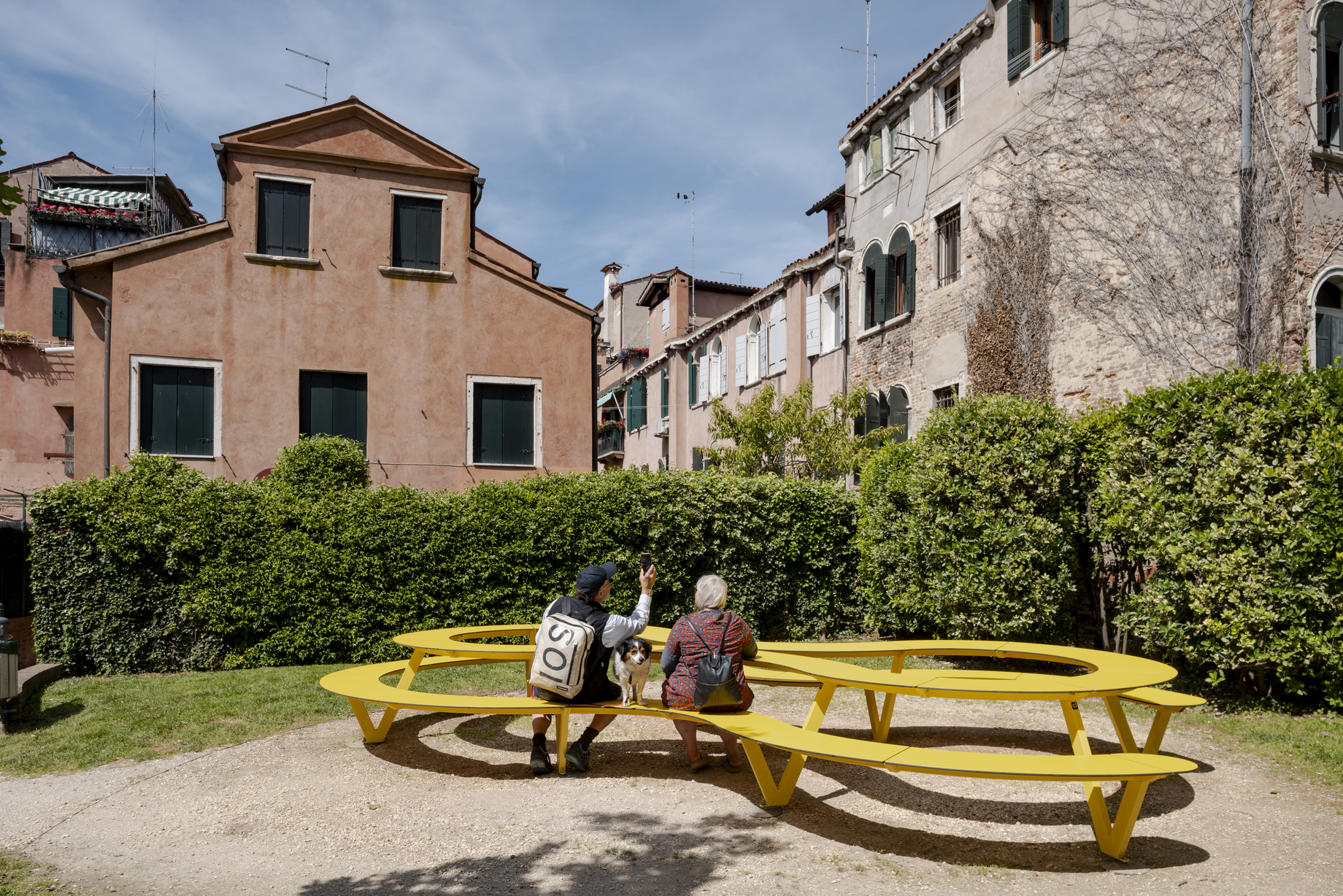
4. King Arthur by miramando. Photo © Matteo Losurdo.
Resilience in Challenging Times
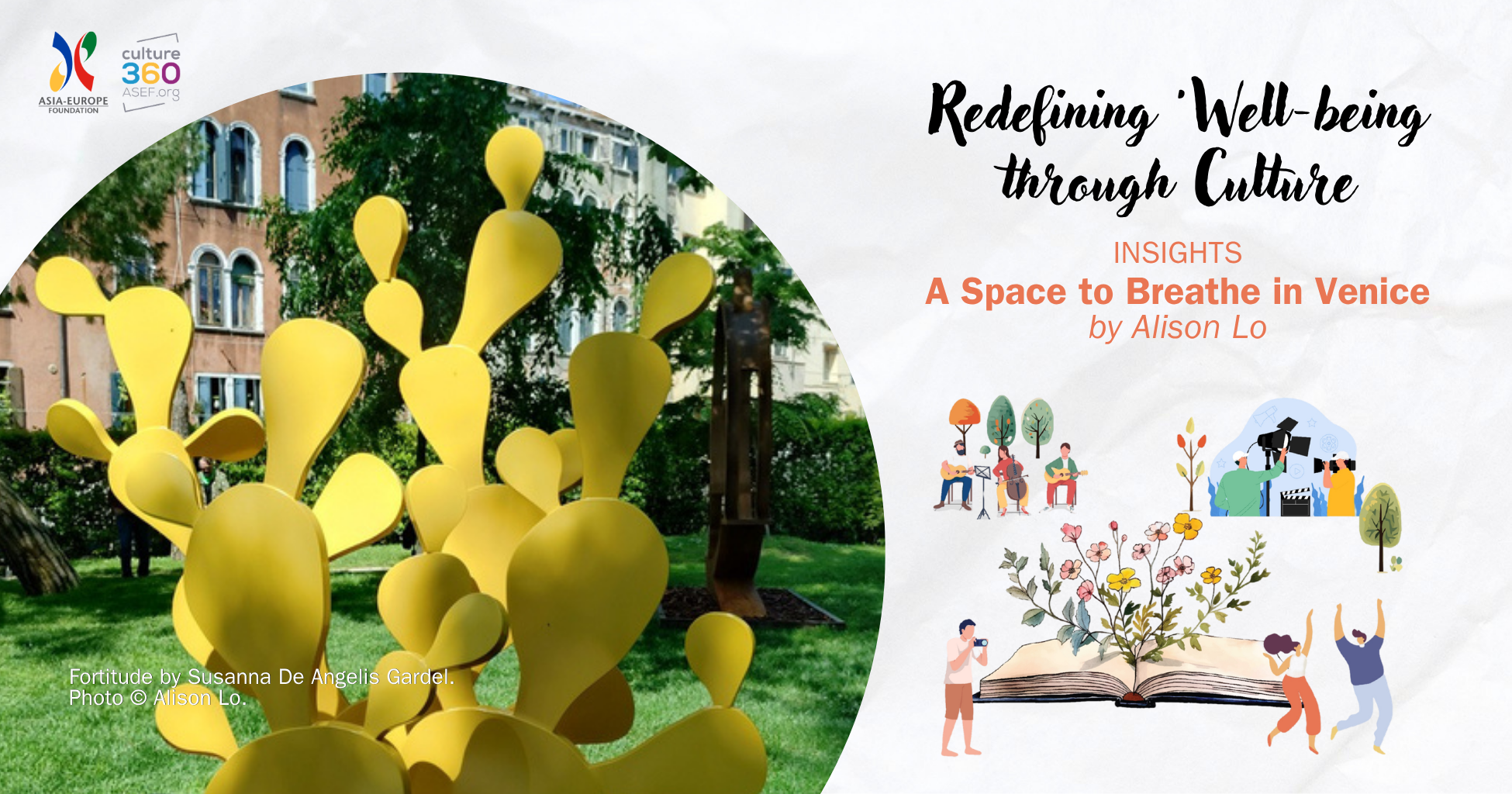
Strolling in the Marinaressa Gardens, one would easily sight a thriving cactus in bright yellow. Fortitude by Susanna De Angelis Gardel is a symbol of quiet resilience and inner strength amid uncertainty. Danieli recounts, “It extends an invitation to reconsider our ability to adapt and to recognise how, even in the most challenging conditions, life always finds a way to emerge.”
In a Biennale often defined by spectacle, competition, and geopolitical friction, Marinaressa Gardens suggests another cultural possibility: art not as escape, but as a shared space for restoration, empathy, and resilience. “We want to create a place where contemporary art could interact directly with nature, public life, and the urban fabric of Venice,” Danieli reflects.
“We hope visitors leave Marinaressa Gardens with a sense of pause and reconnection, with the feeling that contemporary art can still generate moments of connection, contemplation, and humanity within the complexity of today’s world.”
Cover image: Fortitude by Susanna De Angelis Gardel. Photo © Alison Lo.
About the Author
Alison Lo, FRSA is an independent cultural strategist, writer, and curator whose practice engages with contemporary cultural initiatives across Asia and Europe that bridge cultural divides, activate public space, and foster social advancement. She writes for international publications and holds positions as Independent Advisor at Schoeni Projects and Curator at Rossetti Firmenich Art Advisory. Lo is a Fellow of the Royal Society of Arts (RSA) and an Oxford Cultural Leaders (OCL) alumna.