Post-Orientalist Express: Breaking Down Cultural Stereotypes
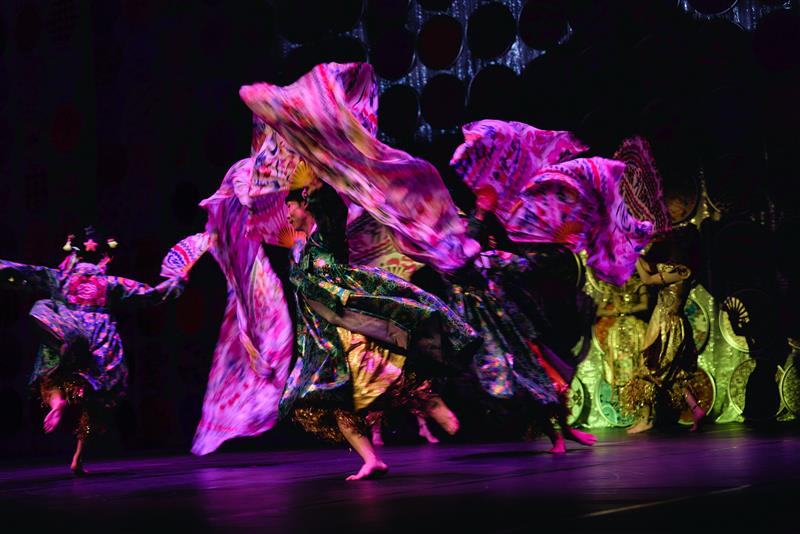
Curator and researcher Dr Katerina Valdivia Bruch provides an analysis of the creation and significance of Post-Orientalist Express, a choreography by Eun-Me Ahn that proposes an Inter-Asian dance language in which cultural contradictions, frictions, and ambiguity offer possibilities to go beyond stereotyping.
Are some languages better than others? Can a dance be composed out of other dances without becoming a cliché or enhancing one dance above the other? These were some of the questions that emerged after watching Post-Orientalist Express, a choreography by Eun-Me Ahn (b. 1963, Seoul), presented in Berlin in November 2025 as part of the Performing Arts Season at the Berliner Festspiele. The piece allows us to question the idea of ‘Asia’ (identified as the Orient) and embarks us in a tour de force composed of different performative traditions, accompanied by electronic music, video projections, and AI-generated images.
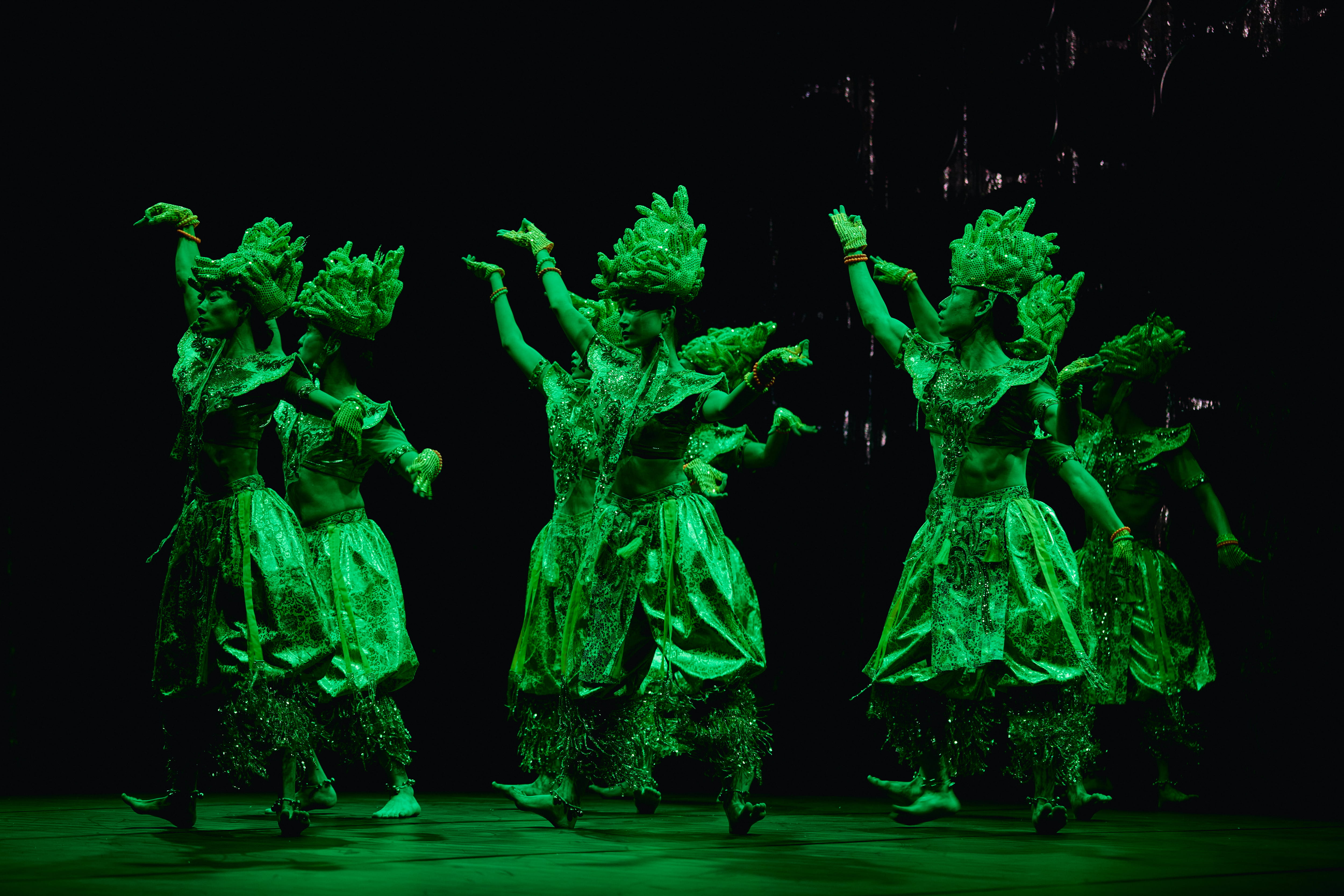
1. "Post-Orientalist Express", Performing Arts Season at Berliner Festspiele, Berlin. Photo © Fabian Schellhorn, 2025.
An Inter-Asian Movement Vocabulary
How Asia is represented cannot be separated from wider economic and geopolitical transformations. The rising economic and political power of some Asian countries in the twenty-first century have opened up new discussions about Asia’s unity within an increasingly multipolar world. These debates have revived – intentionally or not – older ideas of Pan-Asianism, an ideology that emerged in the late nineteenth and early twentieth centuries to confront and end Western imperialism. Yet these ideas were not exempt from contradictions, as they ignored internal differences and reproduced hierarchies within Asia, serving imperial ambitions instead of resisting them. Eun-Me Ahn is aware of these inconsistencies. She believes in a third path: “Both/And, not Either/Or. Bridging does not erase difference; it honours each culture on its own terms and keeps the friction at their points of contact alive. Not unity but dialogue; not a single voice but harmony.” (1)
In terms of choreographic work, Post-Orientalist Express constructs a new language out of several performative traditions. Some movements are reminiscent of Indian Kathakali that appear alongside more linear, subtle movements associated with Japanese Noh theatre. Elements of Korean shamanism effortlessly transition from contemporary dance movements into acrobatics and martial arts. The piece is made up of a patchwork of different dances, creating what she calls “an Inter-Asian dance,” rather than prioritising one dance form over another.
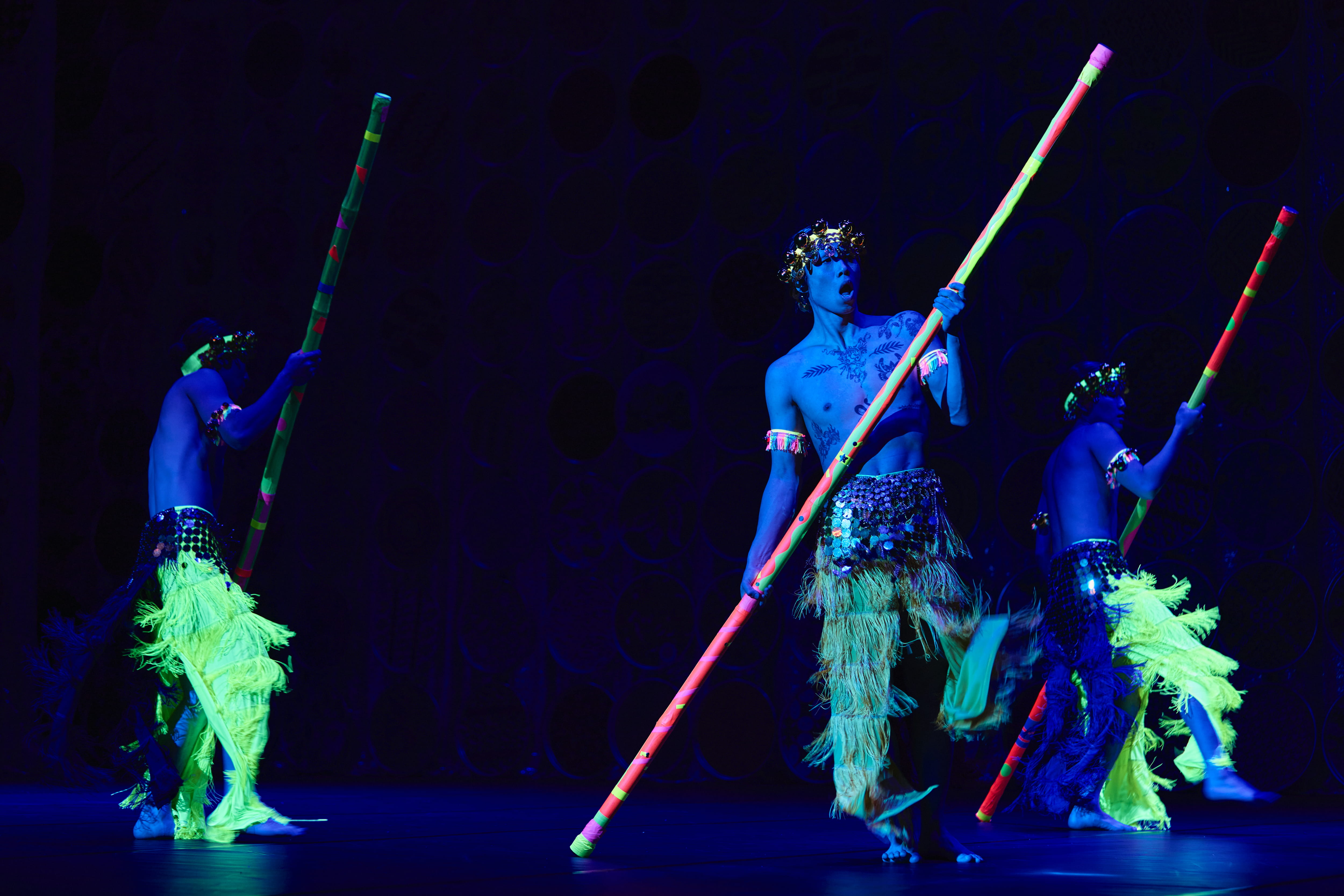
2. "Post-Orientalist Express", Performing Arts Season at Berliner Festspiele, Berlin. Photo © Fabian Schellhorn, 2025.
Beyond Orientalism
At its core, the choreography questions fixed identities and ideas about Asia. To address this, Eun-Me Ahn reflected on Edward Said’s notion of ‘Orientalism.’ Said argues that Western literature, art, academic research, and political discourse have produced an idea of the ‘Orient’ – referring to the countries of Asia, mostly of East Asia –, depicting it as inferior, exotic, irrational, or passive; in comparison to a rational and more progressive West. Initially, these reductions and simplifications of a vast and rich cultural space were created to justify and sustain colonial and imperial agendas. However, despite the end of colonialist rules, these binaries have continued to be part of contemporary cultural imaginaries. Ahn’s Post-Orientalist perspective takes ‘Orientalism’ as a point of departure, going beyond it by breaking with the East–West binary through the integration of their cultural contradictions.
As Eun-Me Ahn noted, “Orientalism is not only a Western gaze. Within Asia, we also Orientalise one another. Recognising this dense web of mutual othering – Korea toward Japan, Japan toward China, China toward Korea – I realised that simple rejection was impossible; it already lives within and among us.” (2) Furthermore, she observed, there have not been enough exchanges among Asians. Instead, a more open culture needs to be developed to find better ways of understanding each other. (3)
To understand her perspective, we shall take a look at the choreographer’s trajectory.
.jpg)
3. "Post-Orientalist Express", Performing Arts Season at Berliner Festspiele, Berlin. Photo © Fabian Schellhorn, 2025.
Culture in Motion
Eun-Me Ahn began her dance education at the age of twelve with traditional Korean dance. Later, she studied contemporary dance at the Ewha Womans University, continuing her education at the Tisch School of the Arts in New York. Korean shamanism (Musok) is also part of her experience. To this, we shall add her lifelong fascination with everyday movement and her work with non-professional dancers. Throughout her career, she has collaborated with elderly women, middle-aged men, as well as with teenagers. For her, technical purity is less important than the fact that people can be themselves through movement, treating artistic and freestyle dance as equally important.
“Post-Orientalist Express understands culture not as a vertical hierarchy but as a horizontal flow, staging “invented traditions” that are endlessly remade within that stream,” says Eun-Me Ahn, emphasising that culture happens through relations and is essentially a process to be reconfigured and questioned over time. (4) Challenging traditions and cultural stereotypes means using them as resources to rearrange and modify, rather than believing they are final truths. As in life, nothing is fixed, a condition that dance embodies with particular clarity.
Cover image: "Post-Orientalist Express", Performing Arts Season at Berliner Festspiele, Berlin. Photo © Fabian Schellhorn, 2025.
References
About the Author
Dr Katerina Valdivia Bruch is an independent curator and researcher based in Berlin. She has curated exhibitions, organised talks and symposia, and collaborated with several institutions, including Haus der Kulturen der Welt (HKW), Hirshhorn Museum and Sculpture Garden, ZKM-Center for Art and Media Karlsruhe, Bielefelder Kunstverein, Kunstmuseum Bonn, Centre de Cultura Contemporània de Barcelona (CCCB), Para/Site Art Space Hong Kong, and the Institute of Contemporary Arts Singapore. She was co-curator of the Prague Triennale "Re-Reading the Future" at the National Gallery in Prague. Besides her work as a curator, she contributes essays and articles to art publications and magazines. Among her research interests are conceptual art, dance, artists’ collectives, video and media art, performativity in the visual arts, cultural policies, and radical pedagogy. https://artatak.net/