
When Craft and Curation Converge
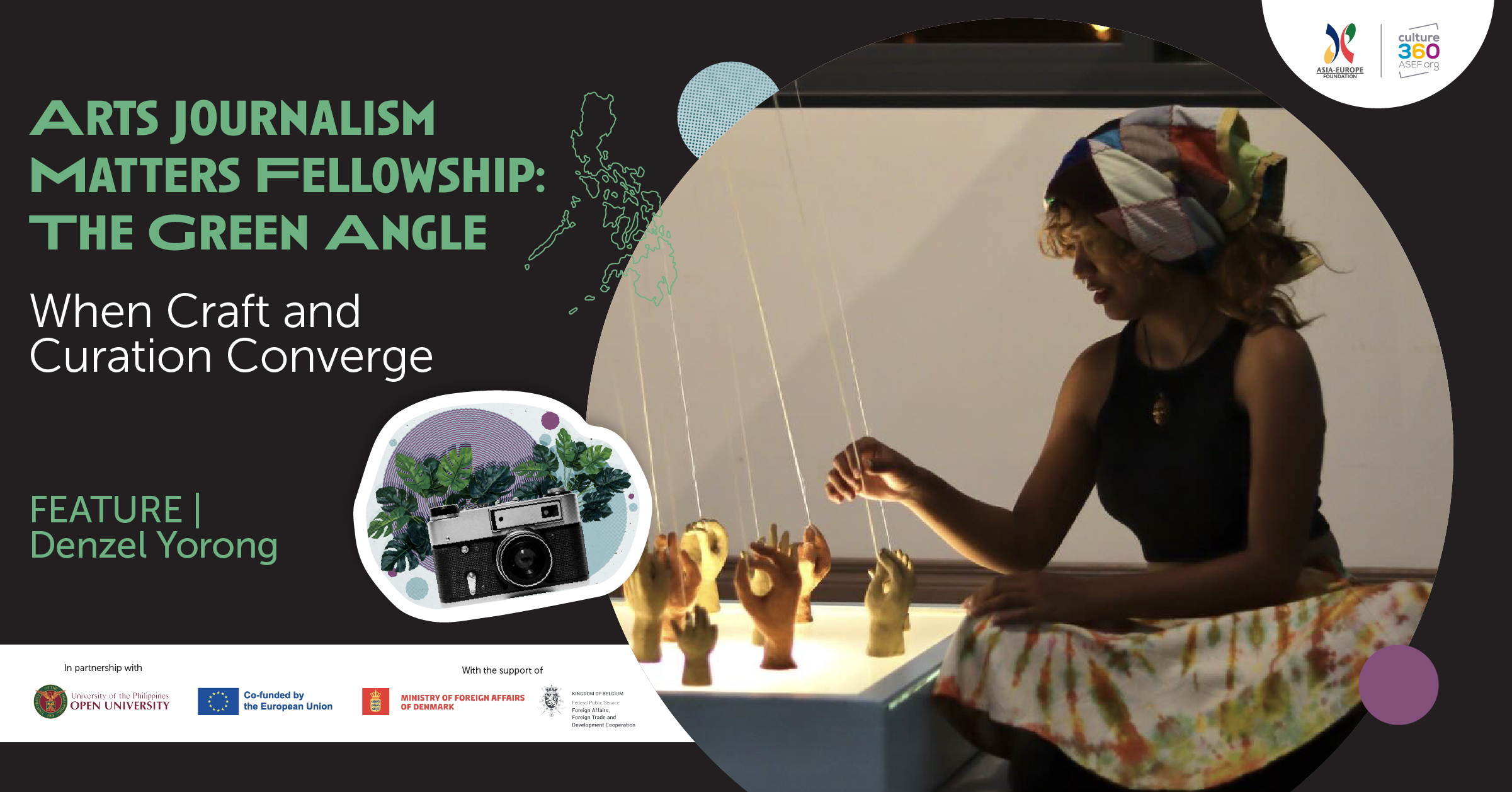
As part of the Arts Journalism Matters Fellowship: The Green Angle, arts journalist Denzel Yorong follows Aklan piña as a living material shaped by soil, season, and inherited skill, showing how ecological attentiveness is carried through generations of makers. Moving between studio, exhibition, and community, the article reflects on how material, place, and care intersect — hinting at larger questions of artistic responsibility, stewardship, and the futures we choose to weave.
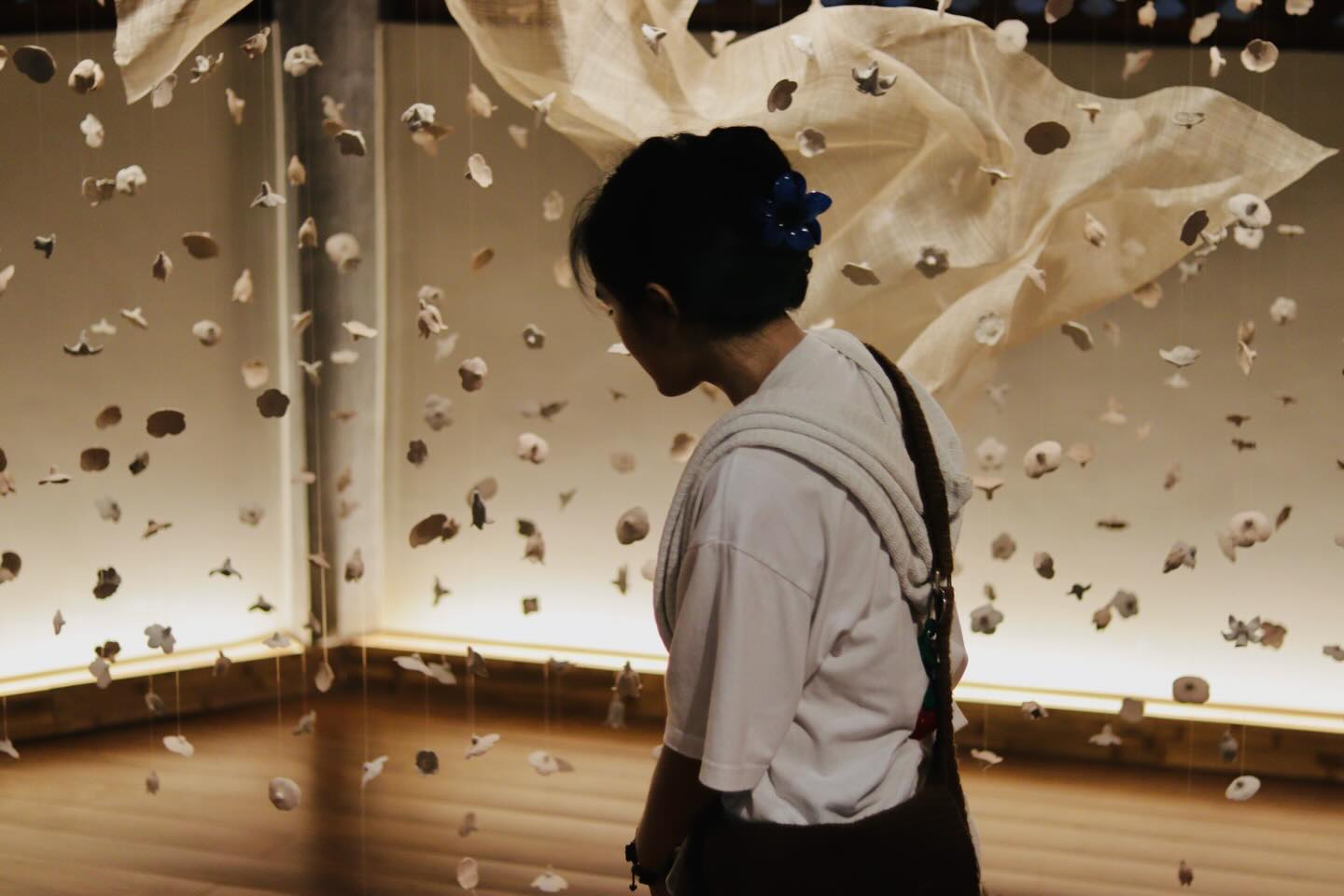
1. Installation view of Rosa Mirasol’s exhibition Santigaman: Paanyayang Manalangin. Photo © Raphael Sayon, Haboean Weaving Studio and Cafe.
Inside the Haboean Weaving Studio in the Philippines, a line on the wall caught the late November light:
“A weaver’s tools go beyond the warp and the weft. They are sharp eyes and quick hands. They are the rhythm of the shuttle and the loom, broken only by the snapping thread or the fading light at the end of day.”
It is this rhythm I came to witness in the province of Aklan, home to the country’s translucent piña – a textile spun from pineapple leaf fibres and a fixture in Filipino ceremonial wear. I saw clues as well. What seems to thrive here, in a tropical microclimate at the northern edge of the central island of Panay, does so by keeping time with the earth.
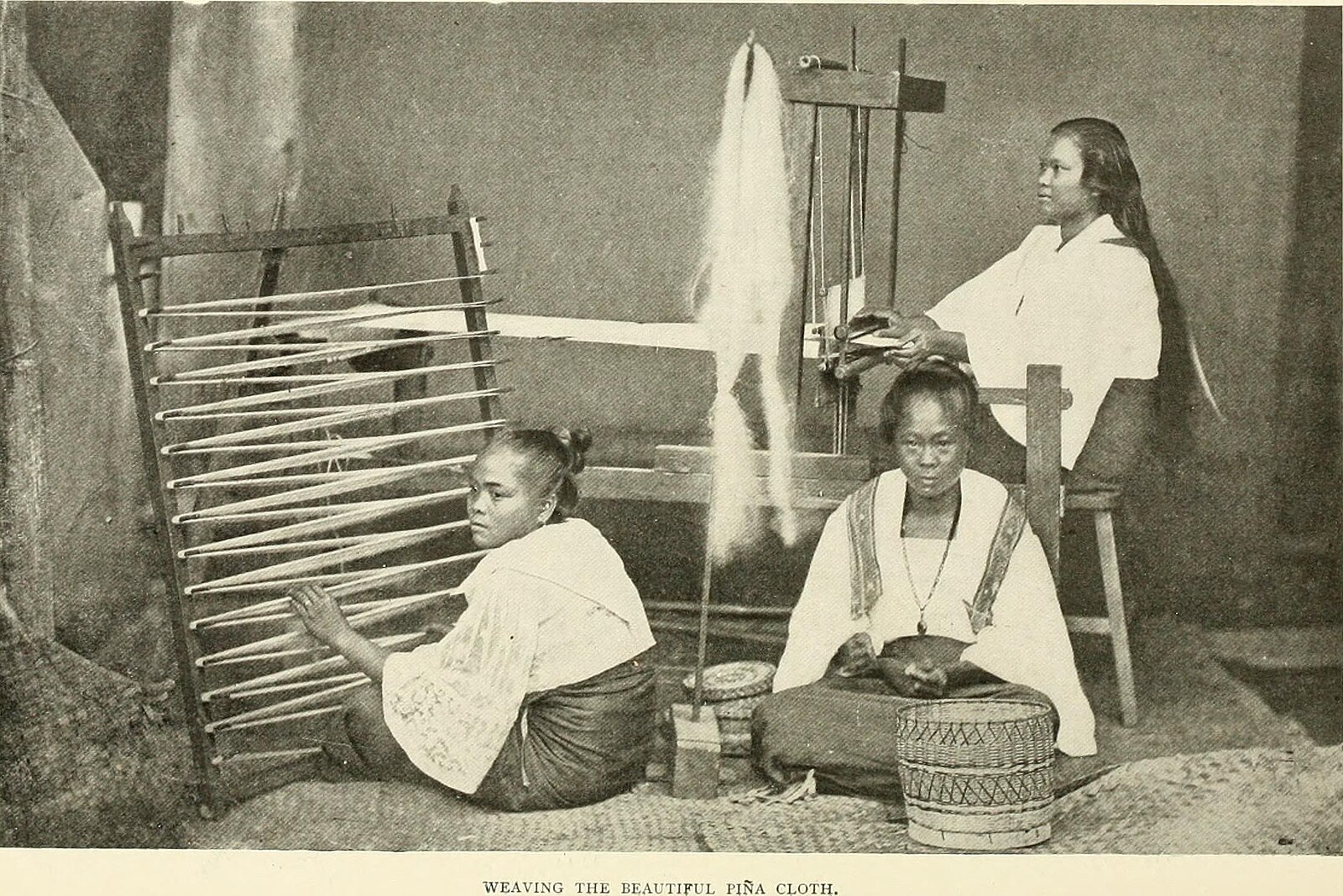
2. Women piña weavers from Panay Island at the turn of the 20th century. Photo © Ramon Reyes Lala, The Philippine Islands.
For artists whose medium is, quite literally, the earth and its produce, such attentiveness to soil and season is instinctive rather than imposed. This framed the Visayas Islands Visual Arts Exhibition and Conference (VIVA ExCon), an artist-run biennial that brings together exhibitions and conferences to foster dialogue, experimentation, and exchange among contemporary visual artists across central Philippines.
So when artists begin to work with such a prized material, a question lingers beyond the loom. If art is tasked with reflecting the times, does it also carry a responsibility to imagine more sustainable futures?
From the studio, I took a tricycle ride to the city center in pursuit of that inquiry. There, the biennale unfolded as an assertion — one that repositioned handloom weaving not only as craft but as custodianship: a shift from inherited technique toward a site of artistic, ethical, and communal claim.
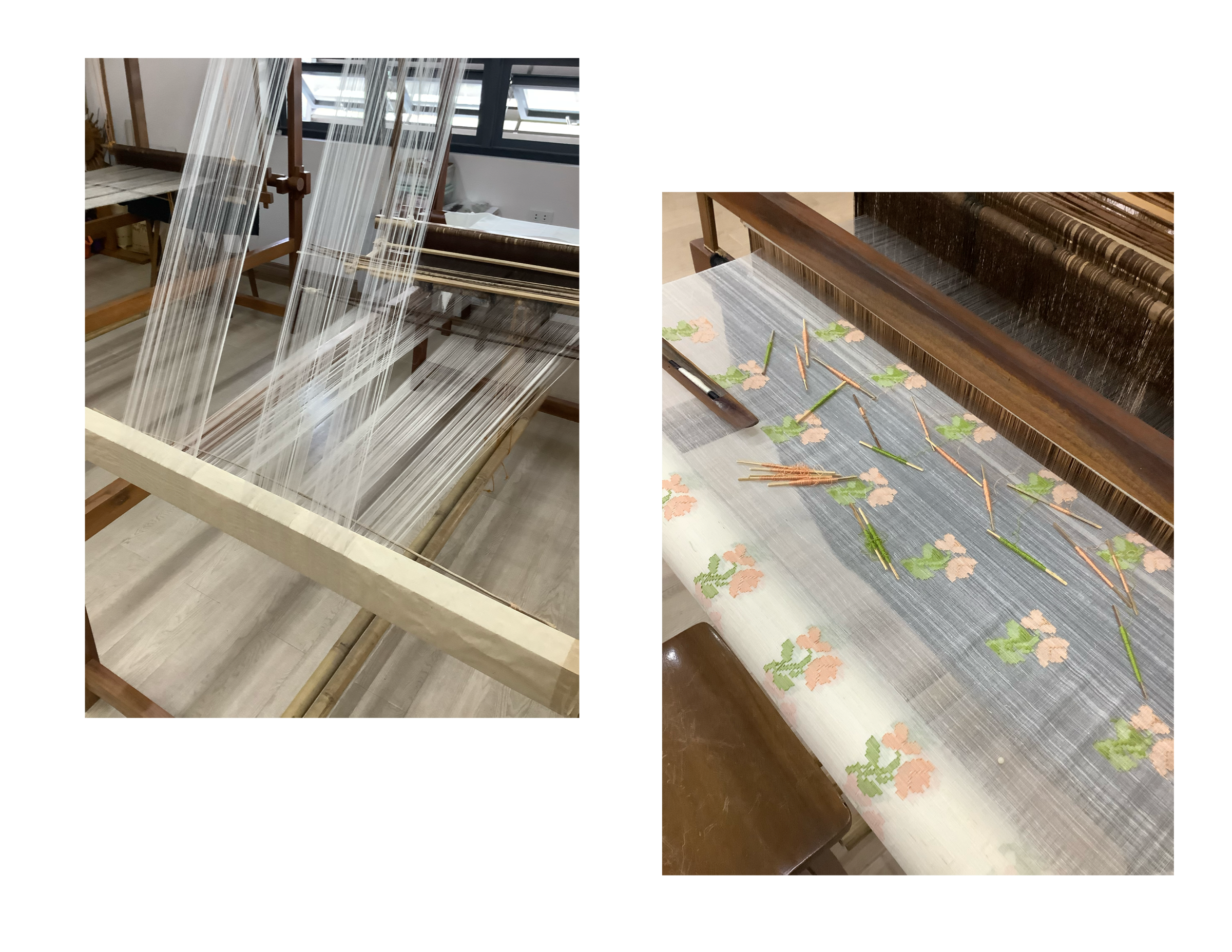
3. In 2023, UNESCO inscribed Aklan piña handloom weaving in its coveted list of Intangible Cultural Heritage of Humanity – a catalogue that includes Italian opera singing, Thailand’s Songkran festival and Palestine’s tatreez embroidery. Photo © Denzel Yorong.
Reimagining Piña
Founded in 1990 by the Black Artists of Asia, VIVA ExCon has shaped how contemporary art in central Philippines understands itself: not as a peripheral echo of Manila’s cultural center, but as a network of practices rooted in distinct geographies, materials, and histories. In its 2025 iteration, curators Abigail Lua and Therese Angela Sulangi made this position more explicit. The biennale’s component exhibition, Ging Sugpon nga Gumon: Reimagining Piña in the Artists’ Hands, foregrounded on experimentation with piña as living material, “reflecting on the fabric’s cultural heritage while considering the textile’s interpretive possibilities.”
“Growing up, piña was framed to us mainly as an industry, something practical and economic,” said Sulangi, an Aklan native whose family comes from five generations of piña weavers. “Because of that I only really began to see its depth and cultural weight much later on.”
In response to the curatorial prompt, some artists went head-on subverting piña’s functional lineage. Margaux Blas’s textile assemblage Central Sun/TheSource, for instance, evoked a pañuelo (traditional scarf) but layered with piña, mesh, scraps, and recycled packaging. Nearby, Kristoffer Ardeña’s Ghost Painting (Toldo Series): Political Promises (Dressed in Barong) installation was draped over an entire wall. Strips of piña alternated with cheaply printed election slogans, turning the textile into a political surface that bears witness to unfulfilled rhetoric in public affairs.
Lua situated this approach within a broader corrective. “A lot of scholarship, especially outside the Philippines, has focused on piña as a marker of 19th century Filipino elite identity,” she noted. “What I love about working with the artists is seeing the many ways they confront and complicate that idea.”
That fixation has deep historical roots. By the 18th and 19th centuries, piña’s fineness made it a favored textile among the Spanish-era elite — worn by illustrados, traded through the Manila galleons, and displayed as a signifier of status. Circulating far from its points of origin, it became a soft commodity of empire: admired by European buyers, preserved in American museum collections, and praised for its delicacy, even as the ecological and artisanal worlds that sustained it remained largely invisible.
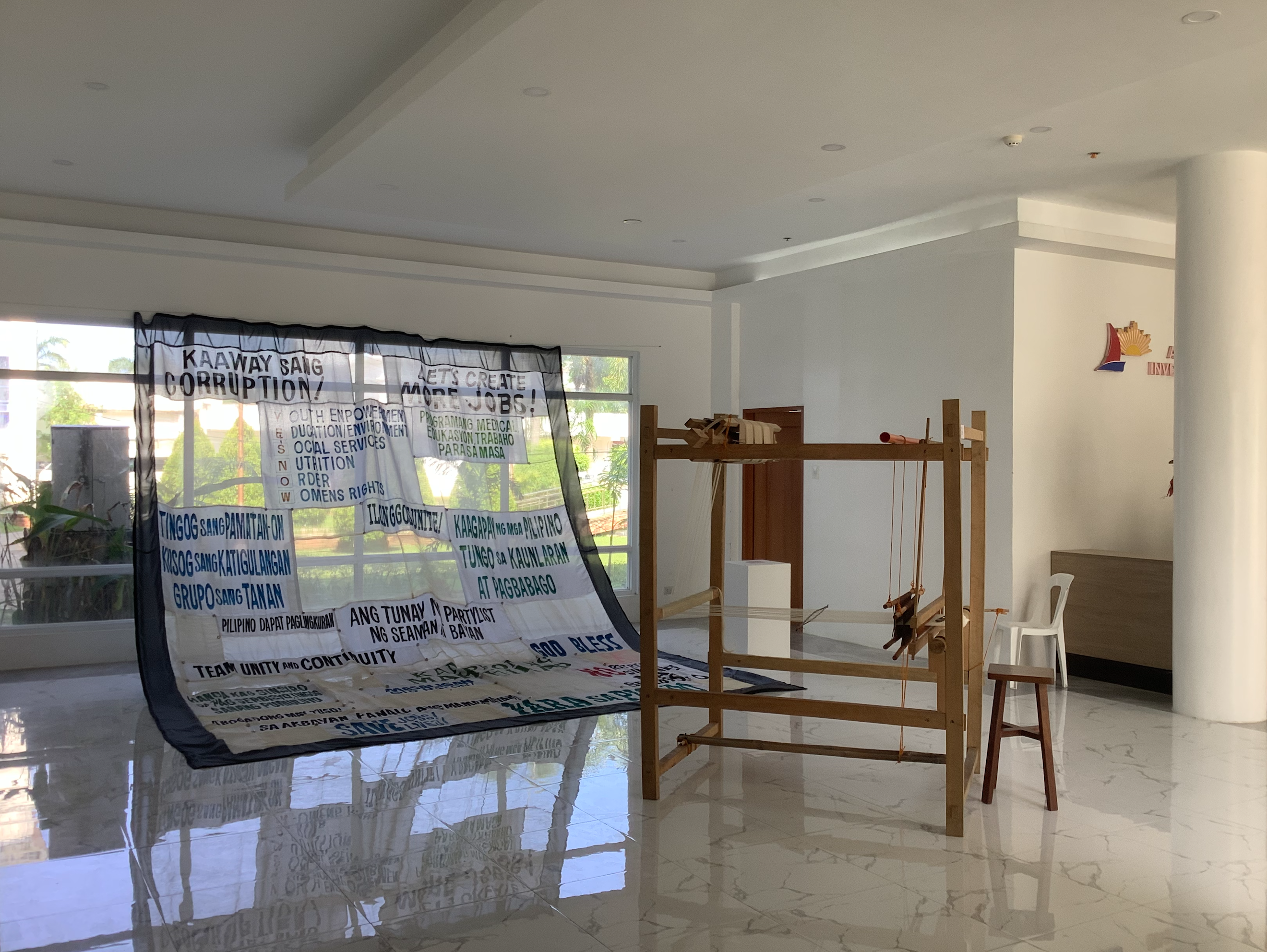
4. Kristoffer Ardeña’s Ghost Painting (Toldo Series): Political Promises. Photo © Denzel Yorong
It is precisely this erasure that artist HeShe Garms took up through an archival lens. Turning attention to what is often overlooked and easily discarded, Garms centred the suksok (inlaid weave) patterns that piña weavers sketch on paper before translating them onto the loom, thereby producing an archive that future makers can return to and rework. “I’ve realised how deeply I love history,” Garms explained, “what it holds, and why it matters to preserve old records of how things were made and how they evolved through time.”
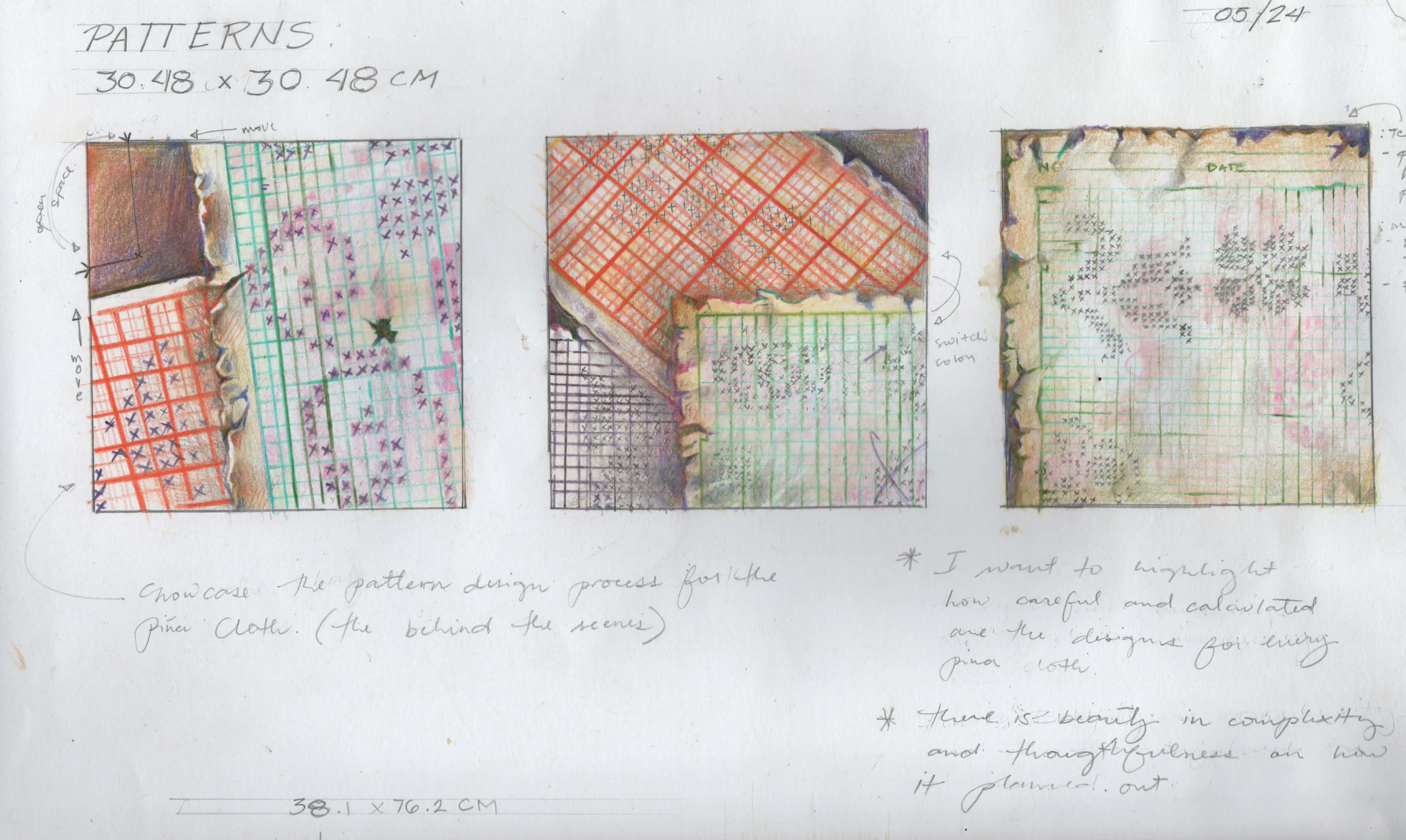
5. HeShe Garms shares her process behind her piece Pattern: Palamuti for the biennale VIVA ExCon. Photo © HeShe Garms.
Asserting communal ownership
The artistic impulse to intervene in the material life of Aklan piña is not simply aesthetic. For artists working with the fabric today, experimentation becomes a way of asking who piña belongs to — and who has long benefited from its beauty without bearing the weight of its making.
The skill of weaving anchors piña production, but it is inseparable from the land that sustains it. Researchers point to Aklan’s rainfall and fertile soil as the conditions that allow the Red Spanish pineapple variety (locally referred to as pinya Bisaya) to thrive. After harvesting, the spiny edges of its leaves are cut away, then scraped — first with broken china to loosen the fibers, then with a smoother coconut shell to draw them out without breaking them. The exposed strands, fine as hair, are washed in clean river water to remove sap, sun-dried, and painstakingly knotted end to end to form continuous thread. Weaving follows on upright handlooms, where tension, humidity, and light must be carefully read; a single misstep can snap the thread and undo hours of labor.
Combined with locally refined weaving techniques, these elements form the fabric’s terroir — the environmental and human convergence that produces the “sheer, lightweight, and ecru-shaded” piña as we know it today.
This close tie between product, place, and people is what qualifies Aklan piña for protection as a geographical indication (GI). The Philippines registers a GI as a good where a given quality, reputation or other characteristic of the good is essentially attributable to its place of origin. Its functions are similar to a trademark: signaling provenance, assuring consistent standards of quality, and distinguishing the product in the marketplace. Indeed, for the producer, it is a grant of protection from deceptive use and acts of unfair competition; for the consumer, a guarantee of authenticity.
Artists do not sit outside this policy; they help make it legible. By foregrounding piña’s material specificity, process, and place-based knowledge, artistic intervention reinforces what the law now recognises: that piña is not merely a textile, but a shared inheritance — one that carries with it an obligation to be passed on, tended to, and reimagined across generations.
Towards reparative curation
Back in the studio, that obligation threaded between tangible and spiritual form.
In one corner, which on ordinary days serves as a prayer room, pottery artist Rosa Mirasol’s installation Santigaman unraveled quietly: a length of piña fabric descending through a constellation of white clay flowers. The work builds from her mother’s pioneering research on santigaman, a devotional practice in which Catholic prayer coexists with older Babaylan rituals, evolving through centuries of colonial entanglement. Returning to the piece now, as a mother herself, Mirasol speaks of a shift in tempo — toward slowness, care, and measured time —allowing the work to move through generations, from mother to daughter to child, and outward to the community.
Across the room, Janine Tolores’ mixed-media exhibition Hibla’t Luwad carried this duty in another register. For the past year, Tolores has been painting on piña, working specifically with retaso — scrap piña that had been stored away and left unused. What began as informal test swatches gradually became a body of works depicting flora and fauna native to the region. By choosing remnants over pristine cloth, Tolores reconfigured preservation not as conservation alone, but as reuse and return, insisting that care for piña also lies in how its leftovers are valued, reworked, and kept in circulation.
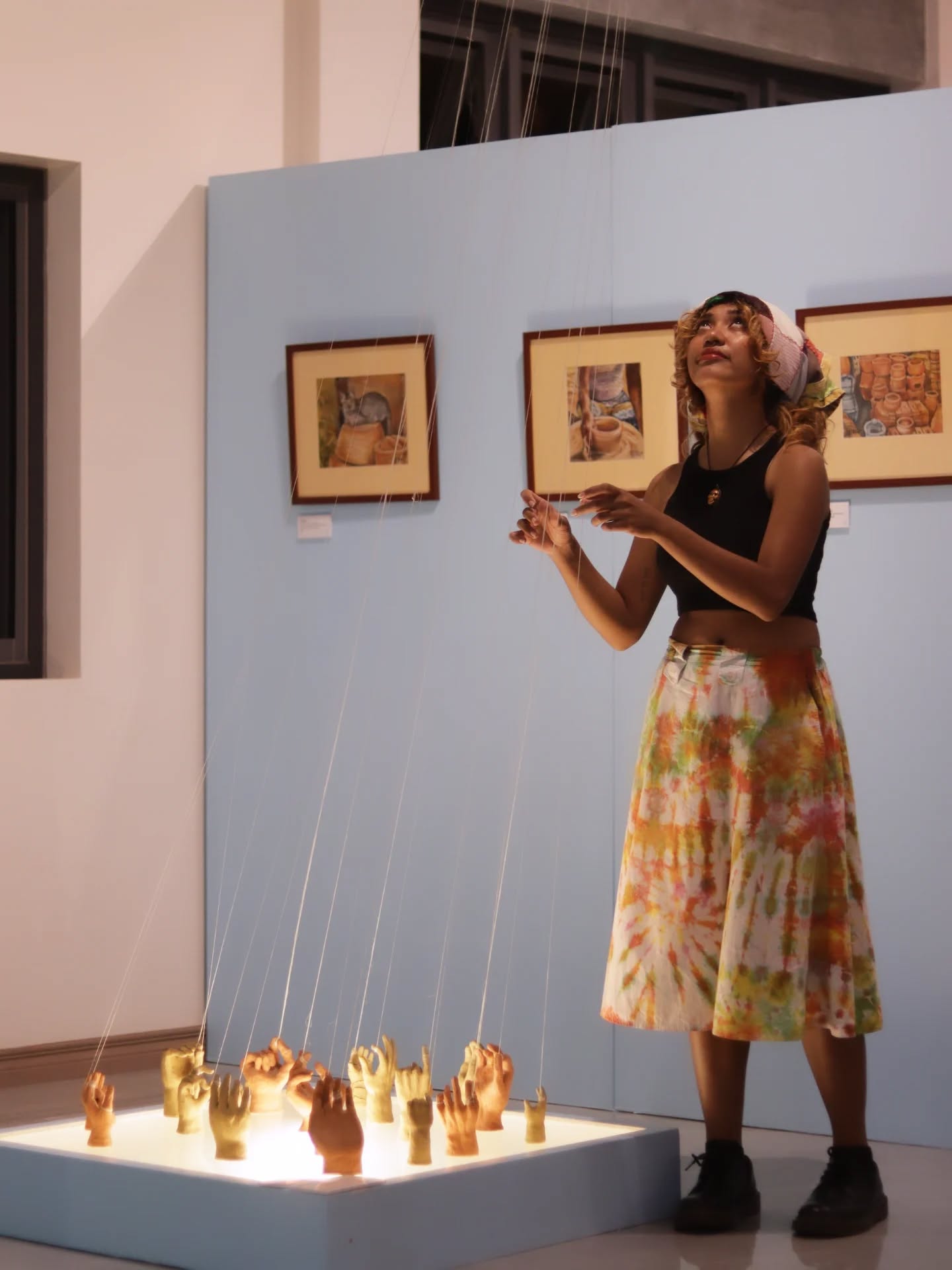
6. Filipino artist Janine Tolores and her piña-based exhibition Hibla’t Luwad. Photo © Raphael Sayon, Haboean Weaving Studio and Cafe.
These exhibitions — biennale-wide or pocket-sized — suggest what reparative curation might look like when practiced in place. Reparative, here, does not mean restoring piña to an imagined precolonial purity, nor does it seek to erase the violence of extraction that shaped its global circulation. Instead, curation becomes a form of restitution — one that recognises inheritance while actively shaping the conditions of its future. By clarifying authorship, reinforcing place-based knowledge, and making visible the collective work behind the fabric, these exhibitions do more than reinterpret material: they help create the scaffolding on which policy can take hold.
As curator Lua noted, there is reason for optimism. “It is really meaningful that the first step of the piña advocacy would be done in Aklan,” she said. “What I hope visitors take away is that the younger generations really do care about carrying this craft forward.”
Seen from Aklan, piña’s future feels neither nostalgic nor abstract. It is being negotiated in studios and fields, in exhibition spaces and policy frameworks, through acts of making that are as deliberate as they are fragile. What these exhibitions make clear is that care — whether aesthetic, legal, or communal — is not incidental to the fabric, but intrinsic to it. To work with piña, today, is to work within a chain of responsibility: one that binds land to labor, heritage to governance, and the present moment to generations still to come.
Cover image: Filipino artist Janine Tolores and her piña-based exhibition Hibla’t Luwad. Photo © Raphael Sayon, Haboean Weaving Studio and Cafe.
The passage quoted at the beginning of the article was written by Chris Mariano.
Links for further reading:
1. UNESCO’s inscription of Aklan piña handloom weaving
2. Interrogating Translucence: Biological and Cultural Definitions of Piña
3. Akan piña’s Manual of Specifications
About the Author
Denzel Yorong (b. 1997) is an independent writer and media producer. He is a finalist for the 2025 Ateneo Art Awards - Purita Kalaw-Ledesma Prizes in Art Criticism. His interests lie at the intersection of cultural governance, intellectual property, and artistic labor.
The Arts Journalism Matters Fellowship: The Green Angle is organised by culture360.ASEF.org, in collaboration with the University of the Philippines Open University (UPOU), which aims to equip emerging journalists in the Philippines with skills, insights and tools necessary to navigate the landscape of writing in and for the arts.
Find out more about the Arts Journalism Matters Fellowship, a hybrid residency and mentorship programme that aims to provide long-term capacity building, networking and peer collaboration opportunties for emerging arts journalists from Asia and Europe.