
Where Artists Stay Sane
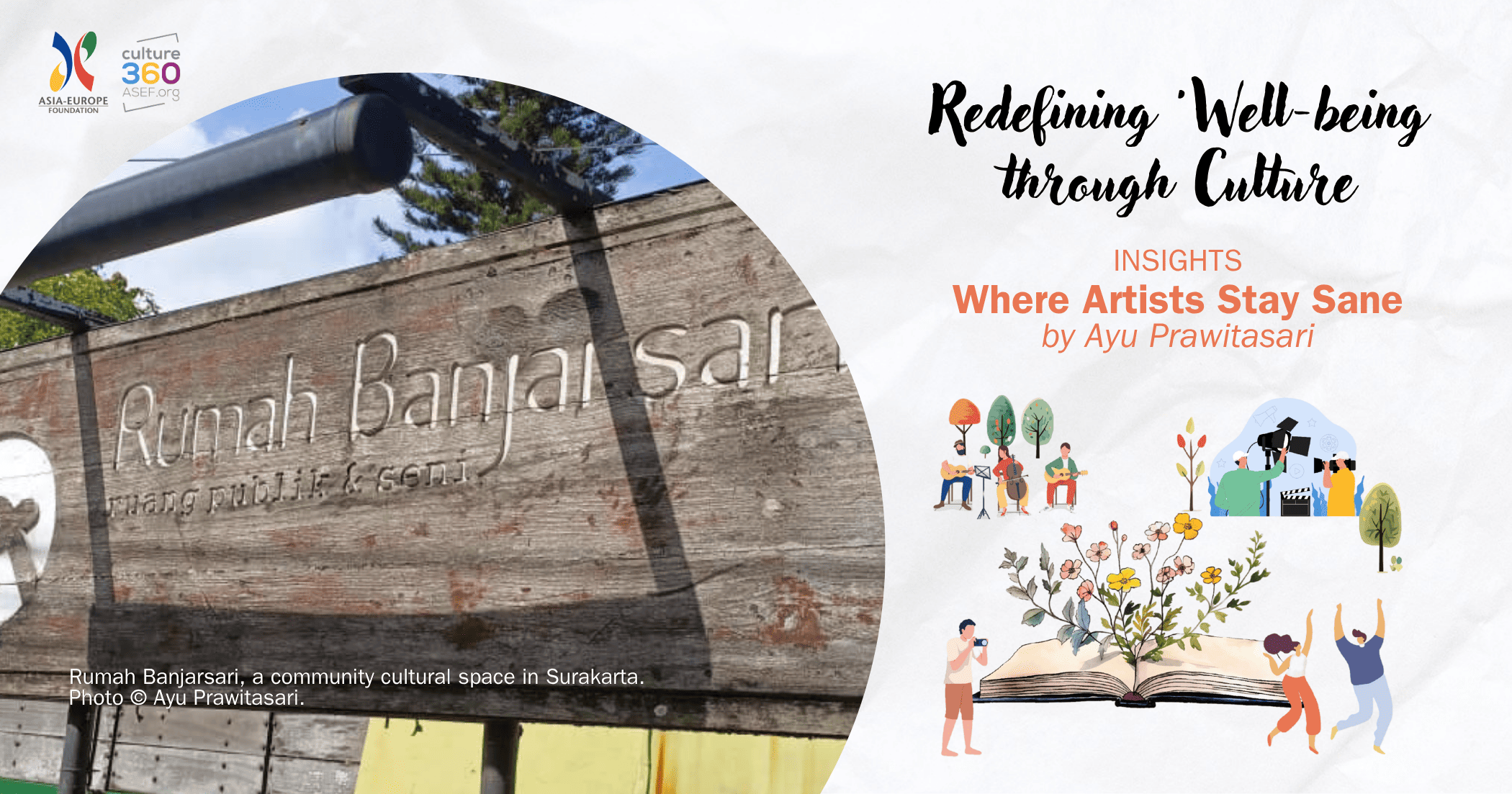
Through a night at Rumah Banjarsari, a community cultural space in Surakarta, Indonesia, this article explores how independent spaces help artists cope with precarity and remain sane.
This article is commissioned as part of culture360.ASEF.org's Redefining 'Well-being' through Culture open call. Through a series of articles, video interviews and podcasts, we delve into the multidimensional contribution of culture towards good physical health, mental health, individual and societal well-being.
Indonesian Artists
Often, being an artist in this country means living with economic conditions that are not entirely stable. This is a common perception that also views art as a hobby, while work is considered something else. As a consequence, artists in Indonesia, particularly those outside the industry, need to have jobs beyond art in order to sustain their “hobby”.
Why does this perception seem reasonable? Data from the Ministry of Tourism in 2021 offers some insight. According to the data, of the 84,006 performing arts workers — 1.09% of the total creative economy workforce — 87.57% earn below the average municipal minimum wage: only Rp1.9 million per month (equivalent to SGD 180-190).
The situation becomes more complex as artists face increasing pressure from the commercialisation of government-owned cultural centres. In contrast to the 1990s, when access to these spaces was almost free and artists could express themselves and create more freely, the early 2000s marked a significant shift in how cultural centres are managed, with the introduction of rental fees that have further restricted artists’ room for movement.
One example is Taman Ismail Marzuki, one of Jakarta’s key arts and cultural centres managed by the Jakarta provincial government. The lowest rental fee for performance space here is around Rp10 million per day (equivalent to approximately SGD 754), meaning that artists would have to spend up to five months of their income just to perform. This rate is relatively high, given its location in the capital.
In other regions, rental costs tend to be lower. At Taman Budaya Jawa Tengah, a provincial cultural centre in Central Java, performance spaces can still be rented for around SGD 75.41 per day, according to the official website.
The implementation of these fees ultimately affects not only artists, who are finding it increasingly difficult to access performance and exhibition spaces, but also the sustainability and character of the cultural centres themselves. In Solo, cultural centres are now more widely known as wedding reception venues rather than as spaces for artistic and cultural practice.
Rumah Banjarsari: A Cultural Space
People in the city of Surakarta refer to this historic building, which covers approximately 1,000 square metres, as Rumah Banjarsari. This grand structure in the heart of the city was once part of Villa Park Banjarsari, an upscale residential area for European and Dutch residents built in the early 20th century. Now known as a public and cultural space, the building is in fact owned by the Mangkunegaran family, a Javanese royal family that forms part of Surakarta’s aristocratic tradition.
Zen Zulkarnaen, an activist, artist, and performer, was the first to initiate the use of this space as a cultural venue. With the permission of the owners, the courtyard and several pavilions — excluding the main house, which is still used by the family — can be used free of charge for community activities. Zen has turned the front and side courtyards into areas for small canteens, while the backyard serves as a hub for community activities, including discussion forums, arts rehearsals (dance and acting), yoga, and martial arts. Theatre performances, music events, and art exhibitions can take place in various corners of the space.
On a Tuesday evening, 9 March 2026, Zen was sitting in the courtyard of Rumah Banjarsari. He now serves as the director of Rumah Banjarsari, which in practice means he carries the responsibility of keeping the space alive.
Steam from coffee and tea mingled with the smell of freshly boiled instant noodles drifting through the air. From nearby tables, fragments of conversations reached my ears again and again, many of them impossible to fully catch. Around five small tables filled the front courtyard of Rumah Banjarsari, crowded with glasses and plates coming and going from two small canteens near the entrance.
Words drifted through the air in fragments: protest, performance, activists, rehearsal. Zen pointed to a group of young people at the table across from us. They were planning a peaceful action in response to the detention of activists involved in mass demonstrations across Indonesia in August 2025 — many of whom have still not been released. The following day, they planned to voice their protest through poetry readings and songs at Rumah Banjarsari.
Other visitors were ordinary residents, many of them parents waiting while their children practised barongsai — the traditional lion dance — in a room at the back of the house. That evening happened to be barongsai practice night, while acting classes, tai chi, and yoga were held on other days. These activities form the backbone of Rumah Banjarsari’s modest operational funding. In many ways, this is where the story begins.
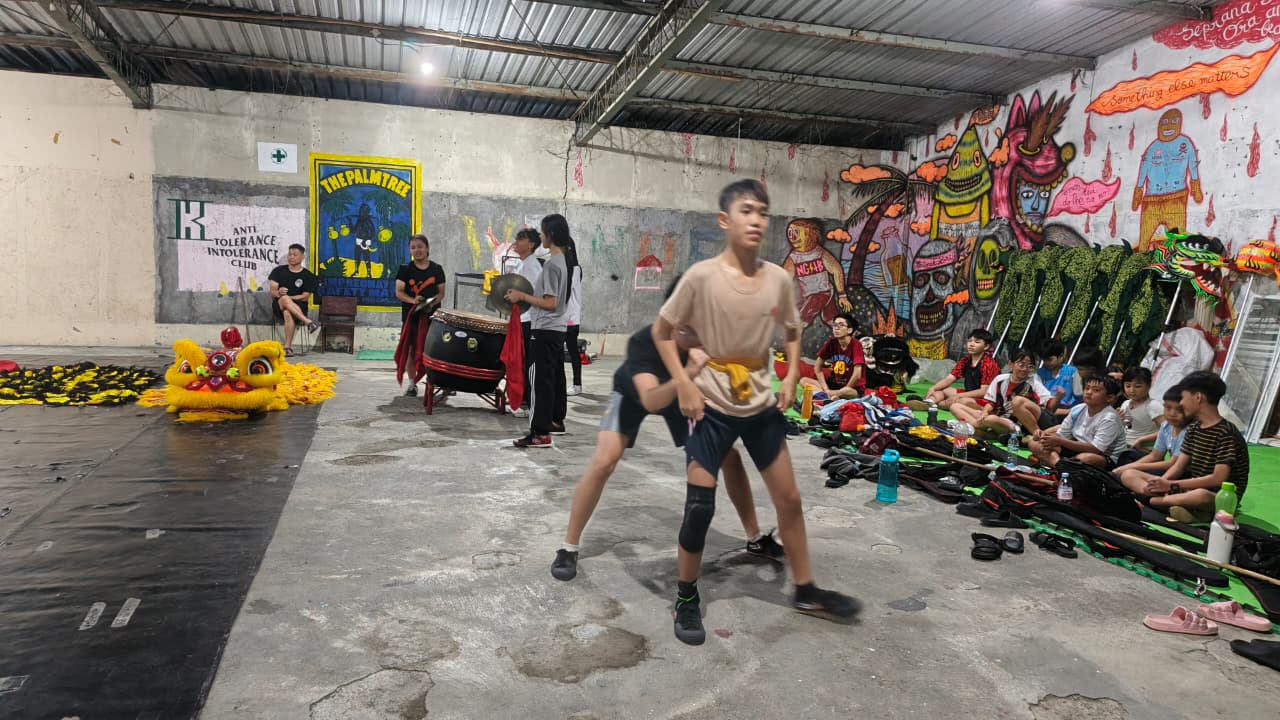
1. Children practise barongsai (lion dance) in a room at the back of Rumah Banjarsari. Photo © Ayu Prawitasari.
Artists Outside the Industry
“How do we see art and artists today?” I asked Zen as he took a long sip from a bottle of cold mineral water. The night was humid, the air heavy as if rain might arrive at any moment.
Zen paused for a while before answering. To understand the situation, he said, we first have to start with a definition of what an artist is; and then recognise the different kinds of artists that exist. For him, artists are simply people who practise art. Those working within the art industry can be seen as professional or commercial artists, while others operate outside that system.
Most of the people active at Rumah Banjarsari, Zen explained, belong to the latter group. They are non-commercial artists who cannot realistically depend on art as their main source of income because they stand outside the industry itself. Zen counts himself among them.
During the day, Zen continued, many of these artists are busy running small businesses — running laundry services or selling rice dishes. By night, however, they transform into presidents, ministers, or even Javanese kings on theatre stages or in poetry performances. Morning belongs to reality, meanwhile night opens a space for imagination through art, a form of healthy catharsis.
Taking the last sip of his drink, Zen assured me that for artists — especially those working outside the commercial art world — the existence of inclusive public spaces like Rumah Banjarsari is crucial. Such places offer a rare refuge amid the economic pressures and social structures that often push them to the margins.
Postponing Madness
“This is a place… to postpone madness,” Zen said. By madness, he was referring to the sense of powerlessness many artists feel — perhaps the most corrosive poison in the world of art.
In the past, that poison took the form of government repression, when authorities controlled artistic content and forced artists into uniformity. Today, it appears in a different form: complicated bureaucracy and rising performance fees. These policies have been introduced in government-run cultural centres after they were given monthly revenue targets to help support the state budget.
As a result, many cultural centres have become increasingly commercial — places that are now far beyond the reach of many artists.
“That is the real problem,” Zen continued.
“When spaces for expression become blocked, what follows is a kind of collective madness. And that is dangerous. Art is about opportunity. It gives people — especially those who feel defeated by social structures — the chance to become someone else on stage.”
Zen paused before adding another example. “Do you remember Wiji Thukul, the poet and activist who disappeared during the authoritarian era?” I nodded.
Wiji Thukul is a powerful example of how an ordinary person — a pedicab driver — could reshape Indonesia’s political landscape through his poetry of resistance. His story also reflects the risks artists face when spaces for expression are constrained or suppressed.
In response to these conditions, Rumah Banjarsari has chosen to take a different approach. The space is committed to hosting a wide range of performances with relatively open curation, and without charging venue rental or ticket fees. In many cases, Rumah Banjarsari becomes the sole sponsor of these events, although occasionally donors or small sponsors step in to help.
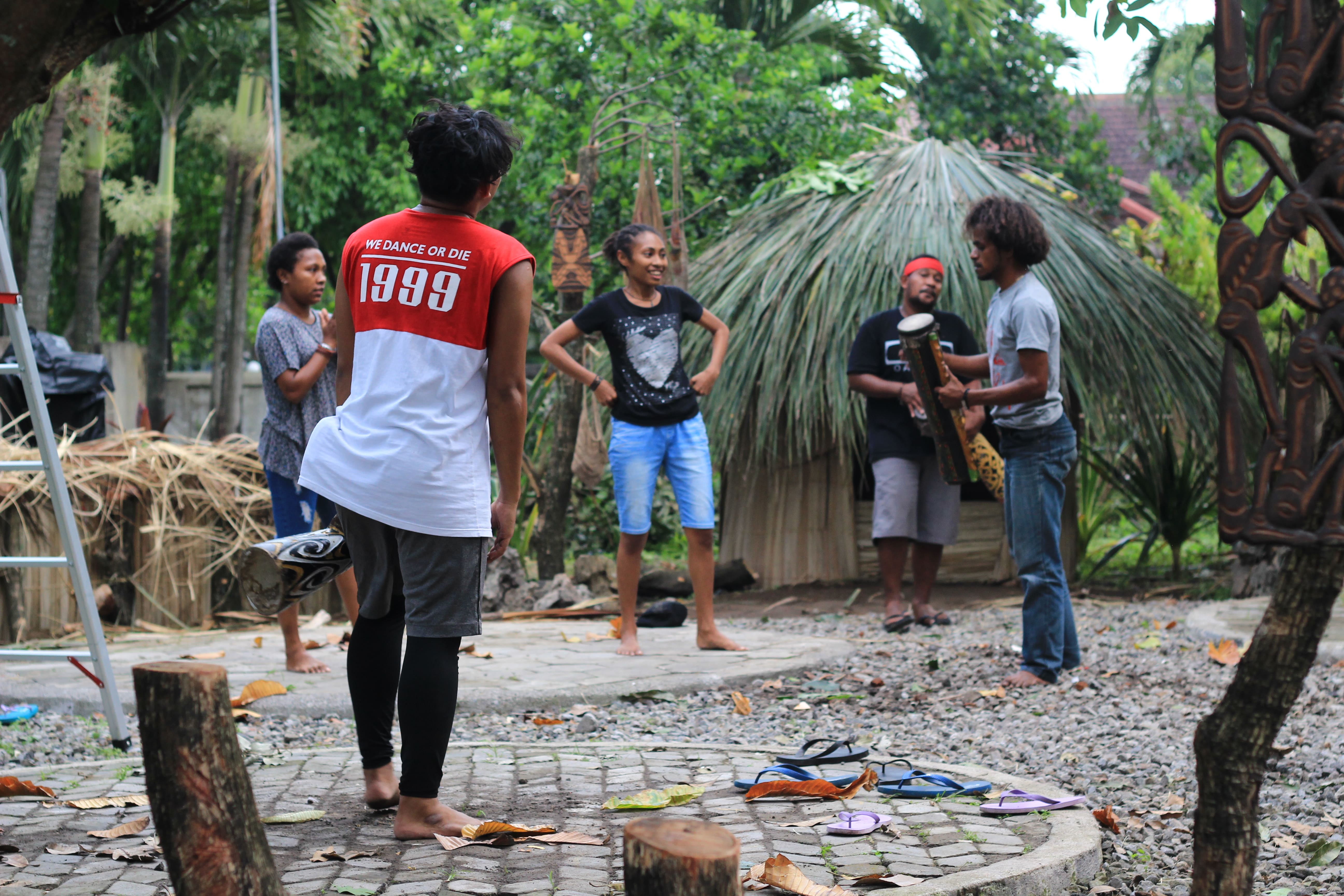
2. Rehearsal for Diru Papua, a performance introducing folklore from across the Indonesian archipelago, held at Rumah Banjarsari in 2018. Photo © Rumah Banjarsari archive.
For Zen, non-commercial performances function as a release valve for the anxieties many artists carry. They offer a space where artists can create freely, without the pressures of market expectations. Here, emotional investment and the subjective experiences of artists are valued as much as the work itself.
For audiences, Zen added, these performances also provide meaningful experiences in a safe way. People do not have to live through the situations that the artworks express, yet they are still able to encounter and reflect on them.
Zen’s final remark lingered in my mind because it echoed the findings of a major study conducted in the United Kingdom. As reported by The Guardian, a government-commissioned study by the Department for Culture, Media and Sport, carried out by Frontier Economics in collaboration with the World Health Organisation’s Collaborating Centre for Arts and Health, estimates that engagement with arts and culture contributes around £8 billion annually to improved wellbeing and productivity.
Ironically, cultural practitioners — the very people who produce meaning and sustain these benefits — often work under fragile conditions: without long-term security, without stable spaces to create, and without adequate mechanisms for psychological recovery.
Listening to the Noise
In this context, an essay by Miranda Anderson in Psyche offers an interesting point of reflection. Anderson invites readers to think about the role of art through a well-known thought experiment proposed by Andy Clark and David Chalmers (1998), which introduced the idea of the extended mind. In their example, Inga relies on her biological memory to find her way to a museum, while Otto — whose brain condition affects his memory — depends on a notebook that stores information externally.
For Anderson, art can function as a similar kind of external cognitive support, helping us make sense of the complexities of the world. It allows people to explore ideas and experiences beyond their immediate reality, challenging habitual ways of thinking and opening new paths towards understanding both ourselves and the world around us. Such possibilities are often harder to sustain in commercial art that depends primarily on market demand and entertainment.
In that sense, Anderson’s reflection makes Zen’s warning about collective madness feel strikingly plausible.
Later that evening, as Rumah Banjarsari grew quieter, a young man approached Zen to discuss a rehearsal schedule for a Subsonic Collapse performance the following week. His name was Nanda Artianto, the owner of B-Lab, a small workshop that develops devices to produce and manipulate sound frequencies — ranging from the rumble of volcanic eruptions to the roar of tsunami waves and other unsettling tones.
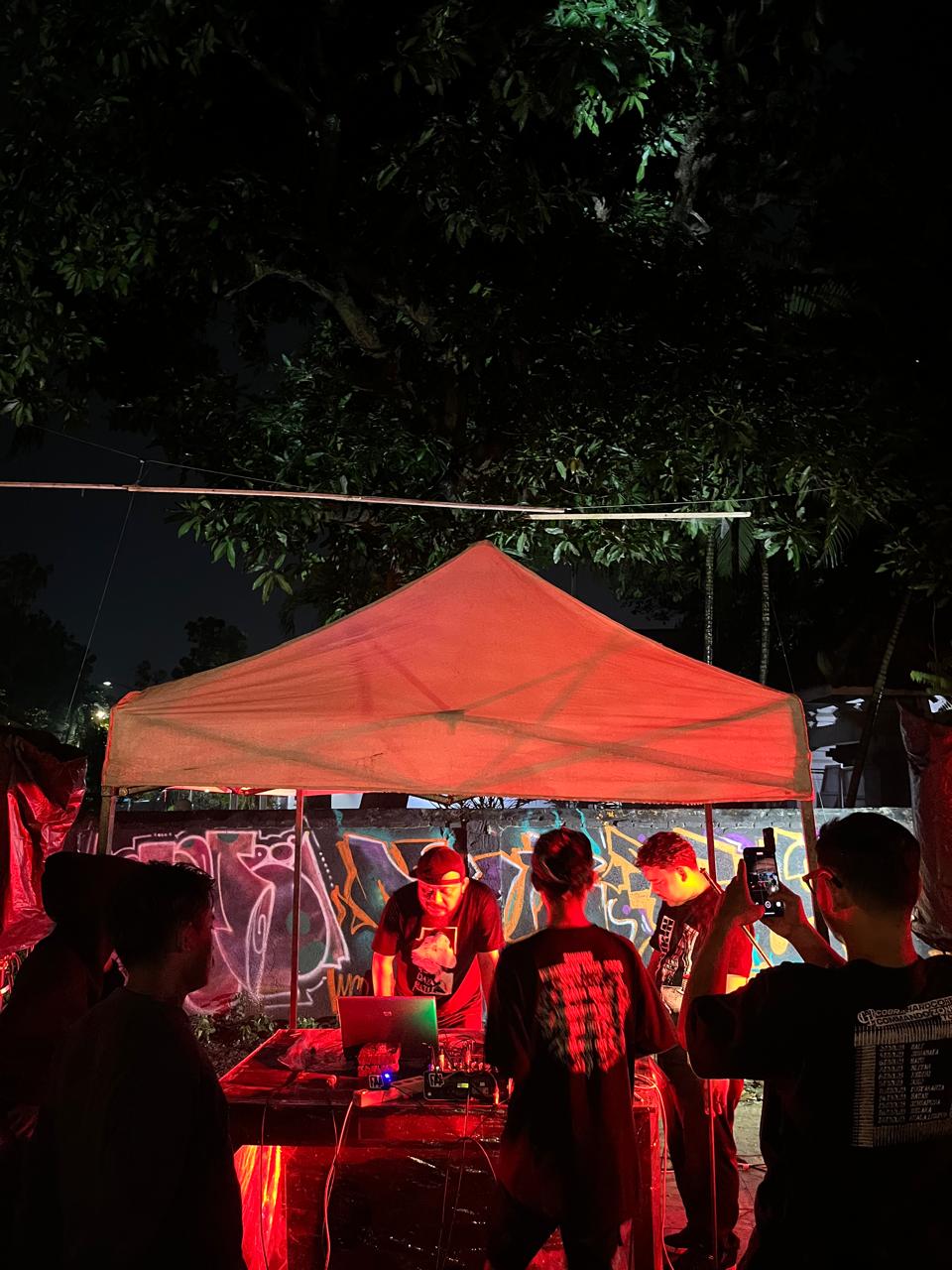
3. Subsonic Collapse performance at Rumah Banjarsari on 9 March 2026, energising the space with their live set. Photo © Documentation of Subsonic Collapse.
“Life gives us constant disturbances,” Nanda said. “They are things we should face, not avoid. Through the sounds we create, we hope to remind people that we are living in a time of crisis.”
As he spoke, a parking attendant dragged a metal sign back into the courtyard, its scraping sound cutting through the quiet. Nanda smiled.
As the evening drew to a close, visitors gradually left the courtyard of Rumah Banjarsari. Many would return the next day to their daily routines — running small businesses, such as laundry services or selling rice dishes.
Yet places like Rumah Banjarsari offer something essential. Not financial stability, but a space where artists can gather, discuss, create, and — if only for a few hours — remain sane. And in their own way, the audience follows them there.
Cover image: Rumah Banjarsari, a community cultural space in Surakarta. Photo © Ayu Prawitasari.
Links for Further Reading
- Can performing Shakespeare help to cure mental illness?
- Yang hilang dari taman budaya bukanlah panggungnya (What is missing from cultural centres is not the stage)
- Lebih dekat dengan Zen Zulkarnaen, Direktur Rumah Banjarsari Solo (A closer look at Zen Zulkarnaen, Director of Rumah Banjarsari Solo)
About the Author
Ayu Prawitasari is an Indonesian journalist, writer, and lecturer at UIN Raden Mas Said Surakarta. She works with Solopos Media Group on journalism training, cultural programmes, and community initiatives. A recipient of the Dana Indonesiana Cultural Endowment Fund, her current work explores Indonesian folktales through a gender and decolonial lens.