Beyond Festival Networking: Curating Conditions for Collaboration
Over five days in Utrecht, seven cultural professionals from Asia and Europe tested a simple proposition: that meaningful international collaboration begins not with projects, but with the relationships that make them possible. Delve into this article to learn more about how AECFest CAMP reimagined the festival as a space for shared inquiry.
International festivals have long been essential spaces for artistic exchange. They bring together artists, curators, producers and presenters from different cultural contexts, creating opportunities to encounter new artistic practices, expand professional networks and initiate collaborations across borders. Yet in a time of increasing geopolitical tensions, constrained cultural mobility and growing pressure on festivals to generate impact beyond artistic presentation, a familiar question deserves renewed attention: how do meaningful international collaborations actually begin?
Against this backdrop, the Asia-Europe Cultural Festival (AECFest) CAMP was conceived as a new initiative by the Asia-Europe Foundation (ASEF): a pilot capacity-building and professional exchange platform embedded within the 8th edition of AECFest and realised in collaboration with SPRING Performing Arts Festival in Utrecht last May.
While conversations around international cultural cooperation often take place among policymakers, researchers, and institutional leaders, the CAMP shifted the focus to a different group: the cultural professionals who shape these collaborations in practice. Over five days, seven mid-career producers, curators, and arts managers from across Asia and Europe were invited not to pitch projects or exchange business cards, but to pause, observe and collectively reflect on their own practice. The question was deceptively simple: what happens when those who build international collaboration are themselves given the time and space to examine how collaboration actually works?
Rather than treating the festival as the backdrop to a professional programme, the CAMP reimagined it as a learning environment. Shared artistic experiences, encounters, and collective reflection became the methodology through which knowledge emerged. The ambition was not simply to strengthen professional networks, but to investigate whether the foundations of long-term collaboration could themselves be curated.
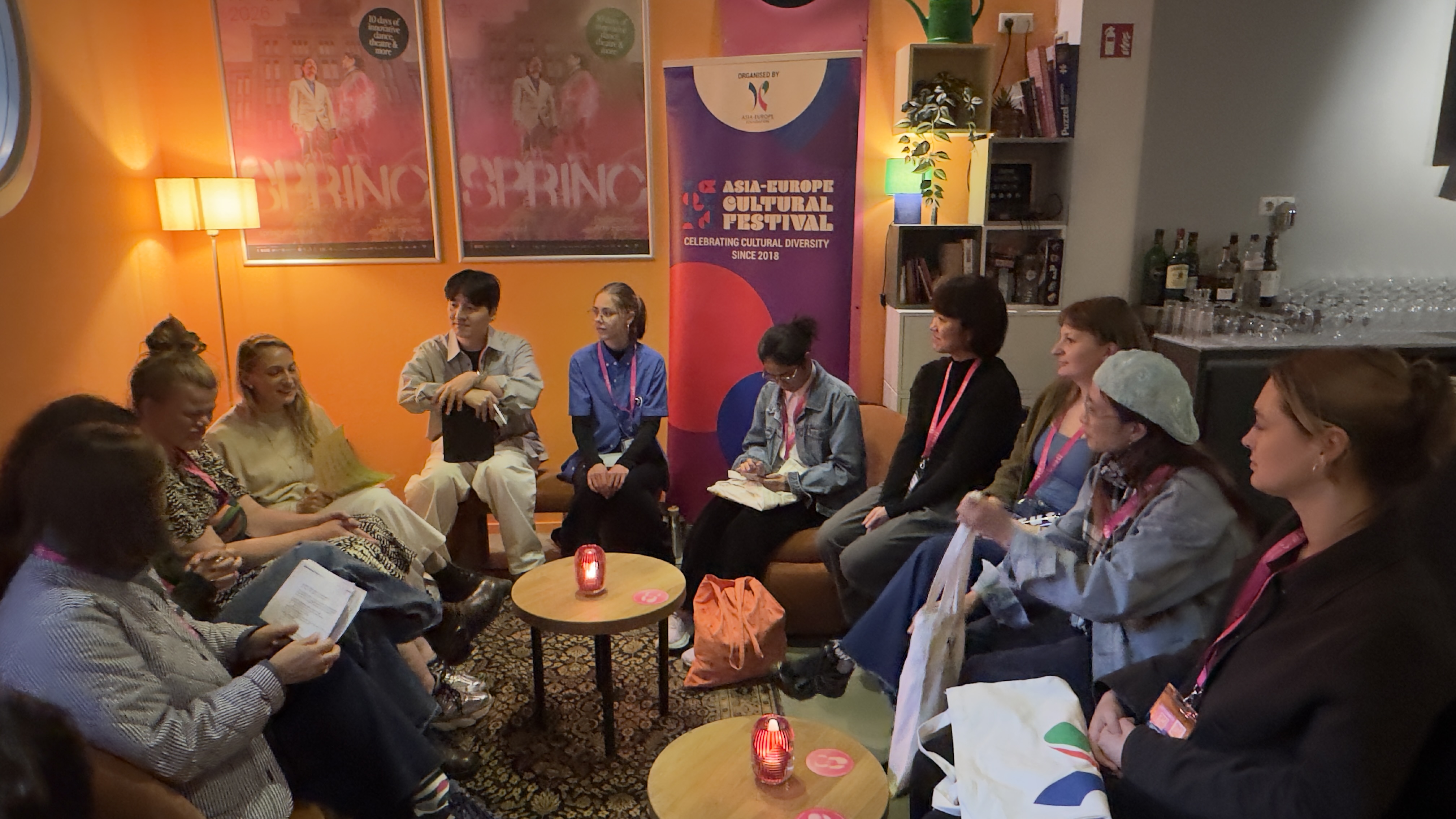
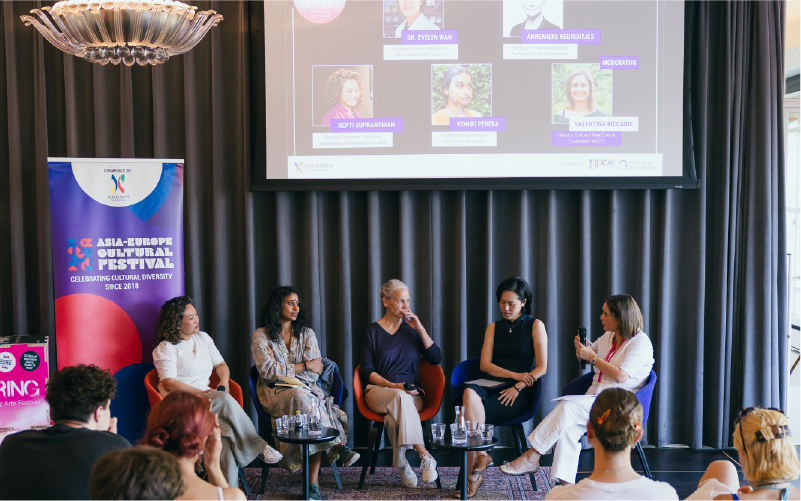
1. Participants gathered at Theater Kikker Café for the Opening Session of AECFest CAMP. Photo © ASEF Culture.
Who Shapes International Collaboration?
The CAMP deliberately focused on a group that is essential to the performing arts ecosystem, but often remains behind the scenes. Its participants were professionals already shaping artistic mobility, commissioning, programming and institutional partnerships in their own context. They are the people who connect artists, negotiate collaborations, navigate funding structures and translate artistic ideas between different cultural and institutional realities. Yet despite their pivotal role, they are rarely the primary beneficiaries of international exchange programmes.
The group was intentionally small, allowing conversations to develop with depth. Equally significant was the diversity of professional practices represented. Participants came from independent festivals, artist-led organisations, residency programmes and public cultural institutions from Japan, South Korea, Thailand, Vietnam, Latvia, the Netherlands and Estonia. Together they brought expertise in producing, dramaturgy, accessibility, cultural policy, artist development and international programming. They also carried with them different funding systems, institutional realities and political contexts. The resulting dialogue therefore extended beyond geography. It became a dialogue between different ways of imagining the role of culture itself.
Curating Learning
The CAMP was built around a simple but ambitious proposition: rather than asking participants to step away from the festival in order to learn, it invited them to learn by inhabiting it.
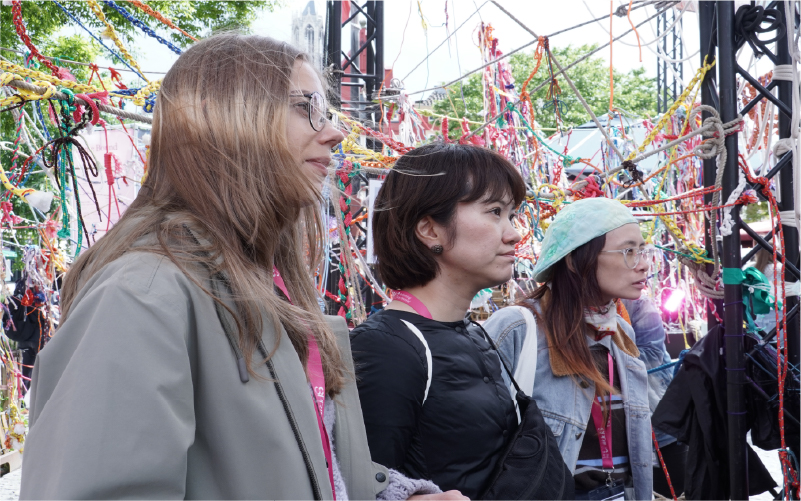
This echoed the curatorial vision of AECFest 2026, Living Across Distance, which explored how relationships are negotiated across geographical, cultural and historical divides through questions of presence, participation, care and shared experience. Rather than discussing these ideas in the abstract, participants encountered them through performances such as Home Bound, Engeki Quest, Work Body, Giselle and Soft Machine, where questions of community, accessibility, decoloniality and the politics of the body unfolded through a range of artistic languages.
Each encounter extended beyond the theatre. Work Body continued through a conversation with its artists and later a reading group. Engeki Quest became an invitation to rediscover Utrecht before participants met its creators. Conversations with artists and presenters, together with thematic sessions at the SPRING Academy, allowed the same questions to reappear from multiple perspectives. Watching was never the end of the experience; it was the beginning of a collective inquiry.
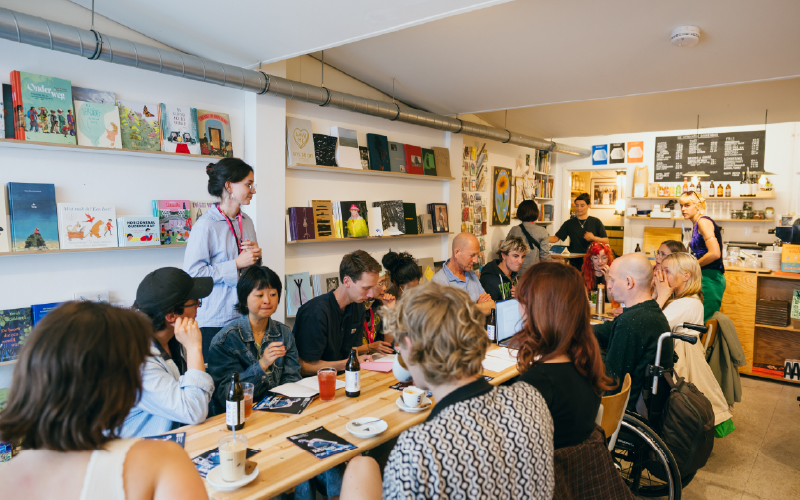
The opening session quietly established this way of working. Participants were not asked to introduce themselves through institutional biographies or recent projects, but to reflect on what they could bring to the group, what they hoped to receive from others, and the questions they wanted to explore together. The words that quickly filled the collective wall were revealing. Rather than "projects", "funding" or "outputs", participants wrote curiosity, conversation, different perspectives, openness, peer exchange and time for reflection. The CAMP did not begin with answers. It began by opening a space in which shared questions could emerge.
Over the following days, those questions travelled with the group. They resurfaced after performances, while cycling between venues, over shared meals and in exchanges that continued long after the theatre had emptied. The boundaries between artistic experience, professional practice and everyday life gradually dissolved, allowing ideas to accumulate, shift and acquire new meanings through repetition.
As Estonian dramaturg Heneliis Notton later reflected, the CAMP created an opportunity to encounter colleagues "as humans and thinkers rather than people carrying the titles of their professional lives." Beginning with sticky notes rather than business cards, and with questions rather than presentations, subtly shifted the terms of the encounter. Professional identities did not disappear, but they became secondary to curiosity.
Perhaps it was no coincidence, then, that one word began to recur across workshops, conversations and interviews without ever having been proposed as an official theme: interdependence.
Understanding Interdependence
No one arrived in Utrecht expecting to spend five days talking about interdependence. Yet, by the final interviews, the word had quietly entered the group's vocabulary, surfacing again and again as participants searched for a way to describe what had happened. Not as a shared definition, but as a shared intuition. It was as though the programme had arrived at a concept only after first living through, and inhabiting, the artistic experiences it created. Although each participant understood it differently, together their reflections revealed an increasingly nuanced understanding of what international collaboration demands.
Vietnamese producer Red offered perhaps the most evocative image, comparing international collaboration to "two or more people walking on a rope while holding hands." Remaining upright, she suggested, depends on trust, careful listening, patience and the willingness to constantly adjust to one another. South Korean arts manager Byungjun Lee located it within the wider performing arts ecosystem, where artists, audiences, institutions and cultural spaces continuously shape one another. Several participants also emphasised that interdependence is never neutral: the connections that sustain international collaboration are structured by unequal access to resources, funding and power.
What emerged over the course of the week was not a new model for collaboration, nor a shared methodology. It was a subtle shift in perspective. Conversations gradually moved away from the question of what might be created together and towards how people learn to work together across different cultural, institutional and political realities. Curiosity, attentive listening and mutual care were no longer abstract values; they had become part of the experience itself.
Perhaps this was the CAMP's most significant insight. Long before a proposal is written or a partnership agreement signed, collaboration takes root where assumptions can be questioned, differences can remain productively unresolved, and relationships are given time to deepen.
The Value of Slowing Down
Another idea returned throughout the CAMP with remarkable consistency: meaningful collaboration requires time.
By the final day, participants were imagining residency programmes, peer-learning networks, co-curation and long-term exchanges rather than immediate productions or touring opportunities. One participant captured the mood in five simple words: "No output. Slow process. Revisit. Rediscover. Flexible." It was not a rejection of outcomes, but a reminder that trust grows slowly, understanding deepens through repetition and genuine partnerships rarely emerge from a single meeting.
The CAMP was, ultimately, an exercise in extending the life of artistic encounters beyond the theatre – less concerned with producing immediate collaborations than with nurturing trust, curiosity and critical dialogue from which future collaborations might emerge.
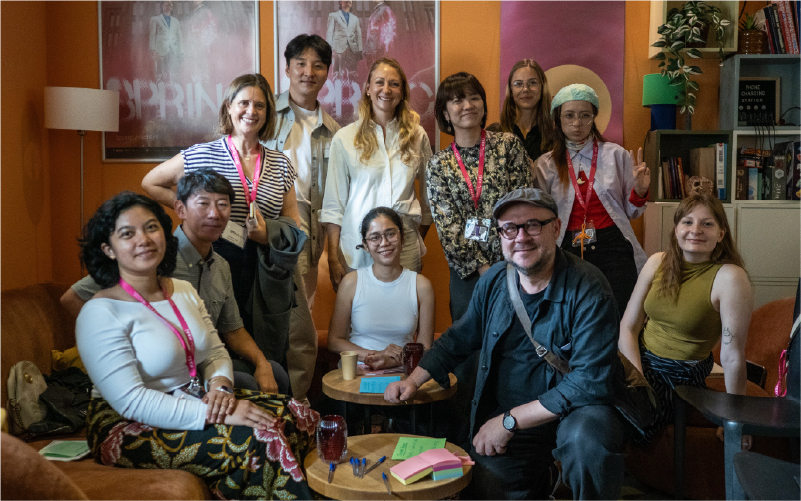
6. Closing Session with AECFest CAMP Participants and Partners. Photo © Giulia Lenzi.
Looking Ahead
As the first pilot edition of the AECFest CAMP came to a close, participants wrote postcards addressed to their future selves, capturing one idea or commitment they wished to carry forward. ASEF will return these postcards several months later — not as a nostalgic souvenir, but as a reminder that the value of an encounter cannot always be measured when it happens. Some conversations need distance before their meaning becomes clear. Some collaborations begin only after people return home.
Perhaps this is what the CAMP ultimately set out to explore. Festivals are often remembered for the performances they present, but their most enduring legacy may lie elsewhere: in the relationships they nurture, the assumptions they unsettle, and the conversations that continue long after the stage has gone dark.
At the end of the week, Latvian creative producer Una Valaine observed that "nothing exists in isolation." It is a simple reflection, but it also answers the question with which the CAMP began. Meaningful international collaboration is less a moment than a practice. It takes shape through the patient cultivation of relationships, curiosity and shared experience.
The first edition of the AECFest CAMP did not seek to provide definitive answers about the future of Asia-Europe cultural collaboration. Instead, it offered something both simpler and more ambitious: the time, trust and shared experience from which future collaborations — and perhaps new ways of imagining cultural exchange between Asia and Europe — can begin.
Perhaps the most consequential encounters begin long before a project has a name — and continue long after a festival has ended.
About the Author
Giulia Poli is an Italian cultural manager and curator with over 17 years of experience in the arts and culture sector. Throughout her career, she has curated more than 300 cultural projects across festivals, theatres, museums, and public spaces, commissioning new works and developing international collaborations. Before joining ASEF, she had held key roles at cultural institutions across Europe and Asia, including Head of Programming for Theatre and Dance at Centro per l’Arte Contemporanea Luigi Pecci (one of the most important Italian contemporary art museums) and consultant for UNESCO.
About AECFest
The Asia–Europe Cultural Festival (AECFest) is the Asia–Europe Foundation's annual flagship arts festival, held each year in partnership with a leading festival in a different host country. Through performances, exhibitions, residencies and professional exchanges, it connects artists and cultural practitioners from Asia and Europe and fosters long-term collaboration.